
MeyerFire
  • Blog
  • Forum
  • TOOLKIT
    • ALL TOOLS
    • BUY THE TOOLKIT
  • UNIVERSITY
    • ALL COURSES
    • JOIN THE UNIVERSITY
  • PE Exam
    • PE Forum & Errata
    • PE Store
    • PE Tools
    • PE PREP SERIES
    • PE 100-Day Marathon
  • LOGIN
    • TOOLKIT-ONLY LOGIN
    • UNIVERSITY LOGIN
  • STORE
  • OUR CAUSE
    • ABOUT MEYERFIRE
    • JOB OPENINGS
    • BECOME AN INSTRUCTOR
    • HELP/SUPPORT
Picture

Is "future use" PIV Req'd to be Open & Connected?

7/18/2023

9 Comments

 
If I have a PIV installed, is it required to be tied into a fire sprinkler system?

I work at a campus style facility with a fire water supply loop for fire sprinklers.

We have a couple of buildings that do not have a fire sprinkler system, however, there is a PIV outside the buildings that are in the closed position. I am assuming they were installed for "future use" assuming a fire sprinkler system gets installed.

Is there an NFPA code reference that requires the PIVs to be "in service" or used for their intended purpose, or are we code compliant with them being "for future use"?

I do have a concern with responding fire units incorrectly assuming that there is a fire sprinkler system in these buildings due to the PIVs being installed.

What are your thoughts?

Thanks!

​​​​​​​​​​​​​​​​​​​​​​​​Sent in anonymously for discussion. Click Title to View | Submit Your Question | Subscribe
9 Comments

Fire Service Required to Run Underneath Footing?

7/12/2023

10 Comments

 
Are you required by NFPA 24 to enter a building underneath the foundation, or can you enter a building with the the fire service main from the side of the building?

Many are under the impression that due to the fact all illustrations in NFPA 24 show the fire main entering under the building, footing/foundation, that this suggests that it is a requirement.

Please can someone shed some light on this?

Regards.

​​​​​​​​​​​​​​​​​​​​​​​Sent in anonymously for discussion. Click Title to View | Submit Your Question | Subscribe
10 Comments

Second Valve Required on a Fire Service Main?

6/7/2023

13 Comments

 
I'm working with a city inspector who is adamant that we add a second non-rising stem valve (NRS) in the fire sprinkler service main just before the building. The first valve being in the street at the live-tap location with the roadway box.

Is a valve required on the service main before the building?

The requested location would place the valve under the sidewalk, accessible by T-handle wrench only, prohibiting reliable supervision of any kind.

I can't seem to find any language in NFPA 24 that I can use to argue against the second unsupervised valve. I don't see any value in the position the inspector has taken and requested a copy of the city ordinance requiring the additional valve.

Installing the second valve wouldn't be a huge deal but certainly seems like an unnecessary opportunity for an unsupervised valve to get closed or fail. I would like to hear what others in this community think and if anyone has something to offer.

Thanks in advance.

​​​​​​​​​​​​​​​​​​​​​​​Sent in anonymously for discussion. Click Title to View | Submit Your Question | Subscribe
13 Comments

HDPE ISO 4427, PE100 SDR Allowed Without FM?

3/29/2023

7 Comments

 
Can HDPE ISO 4427, PE100 SDR 9 PE be used for underground water service pipe (dedicated for fire water), even though it carries no FM Approval?

​​​​​​​​​​​​​​​​​​​​​​Sent in anonymously for discussion. Click Title to View | Submit Your Question | Subscribe
7 Comments

Use Fire Pump at 145% to Avoid 8" Underground?

2/21/2023

17 Comments

 
I have question regarding fire pump capacity.

In my situation the water department is requiring a city tap size to be 2 pipe sizes larger than the fire protection backflow preventer.

In my project, I was using a 4" backflow and 400 gpm fire pump so my underground/city tap would be required to be at least 6 inches.

The AHJ is requiring me to increase the area size in one of my remote areas. So, my sprinkler demand now becomes 582 gpm. To avoid having to use a 500gpm fire pump (with a minimum suction size of 6-inch) and increase the underground to 8-inch, could I still use the 400 gpm fire pump to supply the 582 gpm demand?

This comes out to about 145% of the pumps rated capacity.

I have never come close to the 150% mark before and just want to see what others think. If the underground size wasn't required to be 2 inches larger I wouldn't even think about it and go with the 500 gpm pump.

Thanks in advance.

​​​​​​​​​​​​​​​​​​​​​​​​​​​​Sent in anonymously for discussion. Click Title to View | Submit Your Question | Subscribe
17 Comments

Is Use of C900 for Fire Service Entry Acceptable?

2/16/2023

16 Comments

 
We have a building that is constructed. It has a very deep footing.

The contractor originally submitted an Ames In-Building Riser, but it's too deep for the in-building riser in the building's (essentially) existing condition.

They proposed using C900 to come under the footing, without a sleeve, going below the 12" footing and then stubbing up into the riser room without thrust blocks.

We have concerns about restraint and a change of direction underneath the foundation.

NFPA 13 applies and C900 is a permitted material, which is what the contractor has suggested makes it acceptable.

Is routing C900 under a building footing, changing direction, and then stubbing into the building acceptable?
16 Comments

What Mandates Ductile Iron Until the Backflow?

12/20/2022

18 Comments

 
We are doing the install for a new building. The fire sprinkler underground comes in the building and they are requiring ductile pipe be used inside the building up to the backflow preventer.

Can anyone cite literature for this?

I know NFPA does not require the use of back-flow prevention, but am interested in the code basis for the pipe type until the backflow preventer.

Thanks in advance.

​​​​​​​​​​​​​​​​​​​​​​​​​​​Sent in anonymously for discussion. Click Title to View | Submit Your Question | Subscribe
18 Comments

Underground Pipe Need Sleeve Under Road?

9/30/2022

7 Comments

 
Does plastic underground pipe need to be sleeved when going under a road or driveway?

​​​​​​​​​​​​​​​​​​​​​​​​​Sent in anonymously for discussion. Click Title to View | Submit Your Question | Subscribe
7 Comments

Maximum Allowable Pressure for Fire Hydrant?

8/1/2022

9 Comments

 
We have a proposed fire hydrant in our county that will have pressures ranging from 210 psi to 250 psi according to the engineer designing the underground line.

My Chief and I are looking into this in regards to NFPA standards/applicable code, and are concerned that the high pressure could injure firefighters or damage equipment.

Is there a maximum permitted pressure that a hydrant can be, per code?

Thanks in advance.

​​​​​​​​​​​​​​​​​​​​​​​​​Sent in anonymously for discussion. Click Title to View | Submit Your Question | Subscribe
9 Comments

Restrain Service Pipe by Bolt to Friction Clamps?

6/8/2022

7 Comments

 
I have a job where the plans have a detail of the underground fire service entry into the building that shows us bolting to friction clamps. I've always used the 90-degree I bolts on the flange to shields.

Looking for some detail on this - are there other methods I should be considering? Is this acceptable?

​​​​​​​​​​​​​​​​​​​​​​​​​Sent in anonymously for discussion. Click Title to View | Submit Your Question | Subscribe
7 Comments

When is a Sleeve Required for Sprinkler Riser?

5/17/2022

16 Comments

 
​When is a sleeve required (or not required) at the base of a sprinkler riser when it comes through a floor?

Is there a requirement I'm missing in NFPA 13, NFPA 24, or the plumbing code?

​​​​​​​​​​​​​​​​​​​​​​​​​Sent in anonymously for discussion. Click Title to View | Submit Your Question | Subscribe
16 Comments

Where is C900 Allowed for Underground Service?

3/4/2022

5 Comments

 
When is C900 PVC allowed below buildings before the transition to metallic pipe for spigot stub up?

I often see municipal rules to keep non-metallic pipe no closer than five feet from the building foundation. 

Where does this requirement come from?

I have no problem with this practice but would like some code justification to discuss this with contractors.

Thanks in advance.

​​​​​​​​​​​​​​​​​​​​​​​​​Sent in anonymously for discussion. Click Title to View | Submit Your Question | Subscribe
5 Comments

Pool for High-Rise Secondary Water Supply?

12/28/2021

6 Comments

 
Can a commercial pool be used as the required secondary water supply to a high-rise sprinkler system?

The 2019 IBC/CBC Section 403.3.3 requires an automatic secondary water supply in certain seismic design categories. This is typically met by installing a dedicated tank that meets the minimum demand for 30 minutes.

I have a developer asking if they can run a feed line to their 100k +/- gallon commercial pool so it can serve this purpose.

Outside of the engineering challenges and value engineering their team must address, I'm wondering if this arrangement is even allowed. I cannot find anything in IBC/CBC, NFPA 24, NFPA 13, etc. that wouldn't allow this. Any help is appreciated.

​
6 Comments

How to Start All Municipal Pumps with Flow Test?

12/20/2021

18 Comments

 
We have an oil storage warehouse project requiring a ceiling density of 0.60 gpm/sqft over 3,000 sqft.

This is basically 30 sprinklers using 1,900 gpm (sprinklers), and 500 gpm (for hoses).

The municipal system is set up with three pumps that run sequentially based on residual system pressure. Each pump is larger than the last. We require Pump 3 to be in operation in order to get the required flow and pressure.

We have conducted a flow test flowing two hydrants, and have not been able to kick Pump 3 into action.

Assuming a K16.8 sprinkler has a 3/4" orifice, 30 heads would only equal a 4" diameter opening. If we can't activate the appropriate pump by opening multiple hydrants, how will we be able to achieve the required flow during a fire?

Has anyone encountered a supply system like this before?

I know that a tank and pump is a solution, but I'm looking for other options. Thanks.

​​​​​​​​​​​​​​​​​​​​​​​​Sent in anonymously for discussion. Click Title to View | Submit Your Question | Subscribe
18 Comments

Tap Fire Supply for Water Source Heat Pump?

9/1/2021

8 Comments

 
We are working on a project where the site engineer is asking if tapping into the underground fire line is acceptable to supply a water cooling line to a water source heat pump unit with a 3-inch line.

I'm having trouble finding where it is not acceptable and thought I'd reach out to the knowledgeable members here.

This site has a combination potable/fire line as shown in the picture below.

Should we require them to tie into the 8-inch tap from the potable water line upstream of the fire protection vault (blue line in the drawing)?

Or is it OK that they tap into the fire supply line downstream of the fire protection vault (red line below)?

Picture
​​​​​​​​​​​​​​​​​​​​​​Sent in anonymously for discussion. Click Title to View | Submit Your Question | Subscribe
8 Comments

Is Blazemaster Permitted Underground?

8/31/2021

8 Comments

 
Working on a new resort hotel and it is necessary to have buried pipe before and after a sprinkler control valve.

Is it allowable by code to substitute C900 PVC pipe with Tyco Blazemaster pipe?

According to the installation guide of Tyco Blazemaster it could be installed underground.

If not, which material can be installed instead of C900 because 4-inch is the smallest size for this pipe?

​​​​​​​​​​​​​​​​​​​​​​Sent in anonymously for discussion. Click Title to View | Submit Your Question | Subscribe
8 Comments

Required Fire Hydrant Distance From Building?

8/19/2021

12 Comments

 
We have an project serving the textile manufacturing industry. We are looking to install a fire hydrant (500 gpm minimum) in proximity to the building.

What is the minimum and maximum distance these hydrant(s) should be located from the building?

The project is not under IBC / IFC criteria, only subject to the NFPA series of standards. 

​​​​​​​​​​​​​​​​​​​​​​Sent in anonymously for discussion. Click Title to View | Submit Your Question | Subscribe
12 Comments

Underground Loop Isolation Valve Req'd?

6/24/2021

8 Comments

 
When coming out of a pump room with underground feed which then connects to an underground loop with a bullhead tee, are isolation valves required on the bullhead tee?

​​​​​​​​​​​​​​​​​​​​​Sent in anonymously for discussion. Click Title to View | Submit Your Question | Subscribe
8 Comments

Why Pressure Loss Between Street and Backflow?

1/8/2021

18 Comments

 
We are inspecting an existing fire sprinkler building for an upgrade to an Extra Large Orifice (ELO) system.

We performed a hydrant flow test and noticed a 14 psi static loss between the hydrant, 185-ft of 8-inch ductile, 2 elbows and 8 feet of elevation rise to the supply side of the RPZ backflow preventer.  We recorded 73 psi at hydrant and 59 psi at the number 1 test cock on the RPZ while static.

I spoke with the water authority and they confirmed no meter or check valve on the 8" fire line; it is straight into the valve room plus 2 elbows. The building is 20 years old and the pump test provided 120% of rated capacity.

Any idea how the static pressure inside the building is 14 psi less?

​​​​​​​​Sent in anonymously for discussion. Discuss This | Submit Your Question | Subscribe
18 Comments

Do Other Consultants Review Site Utility Plans?

12/30/2020

11 Comments

 
I've been seven years in the chair, and the most thankless job I encounter on every project is - reviewing the site utility plan and picking it apart.

I've now made my own rule that I will only point the civil engineer's mistakes once, early in the project, and when it comes time to stack the riser, pressure test, etc, all I can say is "I pointed that out to you on Aug 11 2020 email."

Am I going about this the wrong way? SHould I even be investing energy into correcting the engineer with the stamp?

Recent example is a two story building with concrete tees. We're adding third and fourth floors from new structural members. The underground man took the site utility and started digging. Check valve was exposed above ground (supposed to be in pit) and the FDC was connected to the underground on the system side of the backflow preventer. Now he has to dig it up, cap the tee after the backflow preventer, and run it around and inside the building. The job requires a small pump (CL1 manual wet standpipe), and the underground man wasn't happy. All I was doing was point out wrong installations before it was too late.

I'm always left thinking, "this isn't even in my scope of work, but it affects everything downstream."

​​​​​​​Sent in anonymously for discussion. Discuss This | Submit Your Question | Subscribe
11 Comments

Hydrostatic Criteria for Remote FDC in NFPA 25?

10/22/2020

4 Comments

 
We have an account that failed the five year FDC hydrostatic test. The Fire Department Connection is a remote, freestanding FDC. The Fire Marshal is claiming that there is no leakage, however, will not give a pass or fail. 

NFPA 25 (2017) and others reference hydrostatic tests.

6.3.2.1  hydrostatic test 200 psi for 2 hrs or at 50 psi in excess of the maximum pressure where maximum pressure is in excess of 150 psi every five years. (manual standpipe systems and semi-automatic dry standpipe systems, including piping in the FDC)

Annex  6.3.2.1* that mentions a minimum leakage existing under test pressure.

Section 13.8.5 FDC five year hydrostatic testing shall be tested at 150 psi for 2 hrs. There is no mention of minimal leakage allowed.


What is this allowable leakage?

NFPA 24 (2010) Private Fire Mains & Their Appurtenances Section 10.10.2.2.1 requires 200 psi or 50 psi in excess of the system working pressure whichever is greater and maintain that pressure at +/-5 psi for 2 hrs.

Is that my allowable leakage, so that if we lose less than 5 psi or gain no more than 5 psi for 2-hours, that we pass? Wasn't sure if the existing 5-year hydrostatic for underground has leakage that is measured differently from an inside hydrostatic test.
 
Submitted anonymously and posted for discussion. Discuss This | Submit Your Question | Subscribe
4 Comments

Proper Spacing for Private Fire Hydrants?

9/3/2020

7 Comments

 
Is there a standard spacing for private fire hydrants?

No applicable code for this project, but looking for guidance in what would be common under NFPA 24, NFPA 1 / 101, and/or the IBC. Thanks in advance.

​​​​​​​​​​​​​​Submitted anonymously and posted for discussion. Discuss This | Submit Your Question | Subscribe
7 Comments

What is Req'd Pressure and Flow for Hydrants?

8/28/2020

7 Comments

 
What is the residual pressure and flow require for both public and private fire hydrants?

​​​​​​​​​​​​​​Submitted anonymously and posted for discussion. Discuss This | Submit Your Question | Subscribe
7 Comments

How to Verify Flow for Underground Flush Test?

7/31/2020

9 Comments

 
Many sprinkler systems in our area (I'm a fire marshal) have aboveground pipe installed by a fire sprinkler installer and the underground installed by an underground pipe contractor. NFPA 24 requires a minimum flow rate from underground pipe in order to remove rock and debris from the underground pipe.

Many of the underground contractors simply open up the pipe and wait until there's consistent clear water and/or stop hearing the rocks ping around. There's no measurements taken for the underground flushing and when I ask for them to verify the flow rate I get blank stares.

Is there a way to tell just by static pressure in the area if opening up the pipe flange is enough flow to satisfy the underground flushing? Or is there a measurement I should be seeing to verify the flow rate? 

Thanks in advance.

​​​​​​​​Submitted anonymously and posted for discussion. Discuss This | Submit Your Question | Subscribe
9 Comments

Why Does a Hydrant Need a Control Valve?

7/10/2020

9 Comments

 
NFPA 24, Section 7.1.1.2 (2016 Edition), states that control valve shall be installed in each hydrant connection.

What is the purpose of this control valve, other than facilitating maintenance?

Would this be considered a "control valve" per NFPA 24 3.3.3, and does this have to be a post-indicating type valve?
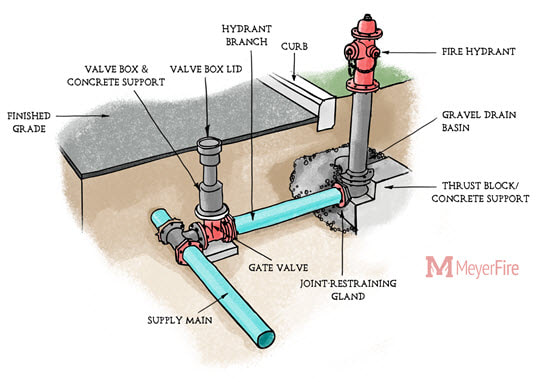
Picture
​Common hydrant arrangement for illustration purposes.
Based on my limited understanding, this control valve is just a post-indicator valve/isolation valve which is for shutoff when there is an impairment downstream. I'm trying to get a better understanding of its purpose. Thanks in advance.

​​​Submitted anonymously and posted for discussion. Discuss This | Submit Your Question | Subscribe
9 Comments
<<Previous
Forward>>
    SUBMIT A QUESTION
    Picture
    Why Sponsor?

    ALL-ACCESS

    Picture
    GET ALL OUR TOOLS

    SUBSCRIBE

    Subscribe and learn something new each day:
    I'm Interested In:

    COMMUNITY

    Top Oct '25 Contributors
    Picture
    Picture
    Picture
    Picture
    Picture
    Picture
    Picture
    Picture
    Picture
    Picture
    SEE LEADERBOARD

    YOUR POST

    SUBMIT A QUESTION

    PE EXAM

    Get 100 Days of Free Sample Questions right to you!
    SIGN ME UP!

    FILTERS

    All
    A1171
    ABA
    ADA
    ASCE 7
    ASME A17.1
    ASTM E1354
    Blog Thread
    Daily Discussion
    Design-documents
    EN 12259-1
    EN 12845
    Explosion Protection
    Explosion-protection-prevention
    Fire Detection And Alarm Systems
    Fire Dynamics
    Flammable And Combustible Liquids
    Flammable-combustible-liquids
    FM Global
    Human-behavior
    IBC
    ICC 500
    IEBC
    IFC
    IMC
    IPC
    IRC
    ISO
    Means Of Egress
    NBC
    NFPA 1
    NFPA 10
    NFPA 101
    NFPA 11
    NFPA 110
    NFPA 1142
    NFPA 1221
    NFPA 13
    NFPA 13D
    NFPA 13R
    NFPA 14
    NFPA 15
    NFPA 16
    NFPA 17A
    NFPA 20
    NFPA 2001
    NFPA 214
    NFPA 22
    NFPA 220
    NFPA 24
    NFPA 241
    NFPA 25
    NFPA 291
    NFPA 30
    NFPA 307
    NFPA 30B
    NFPA 31
    NFPA 33
    NFPA 37
    NFPA 400
    Nfpa-409
    Nfpa-415
    Nfpa-45
    Nfpa-495
    NFPA 497
    NFPA 5000
    NFPA 502
    NFPA 54
    NFPA 55
    NFPA 654
    NFPA 68
    NFPA 70
    NFPA 701
    NFPA 72
    NFPA 75
    NFPA 770
    NFPA 82
    NFPA 850
    NFPA 855
    NFPA 90A
    NFPA 92
    NFPA 96
    NICET
    OBC
    OSHA
    Passive Building Systems
    PE Prep Guide
    PE Prep Series
    PE Sample Problems
    Poll
    Smoke Management
    Special Hazard Systems
    UFC 3-600-01
    UFC 4-021-01
    UFC 4-211-01
    UPC
    Updates
    Water Based Fire Suppression
    Weekly Exams


    ARCHIVES

    November 2025
    October 2025
    September 2025
    August 2025
    July 2025
    June 2025
    May 2025
    April 2025
    March 2025
    February 2025
    January 2025
    December 2024
    November 2024
    October 2024
    September 2024
    August 2024
    July 2024
    June 2024
    May 2024
    April 2024
    March 2024
    February 2024
    January 2024
    December 2023
    November 2023
    October 2023
    September 2023
    August 2023
    July 2023
    June 2023
    May 2023
    April 2023
    March 2023
    February 2023
    January 2023
    December 2022
    November 2022
    October 2022
    September 2022
    August 2022
    July 2022
    June 2022
    May 2022
    April 2022
    March 2022
    February 2022
    January 2022
    December 2021
    November 2021
    October 2021
    September 2021
    August 2021
    July 2021
    June 2021
    May 2021
    April 2021
    March 2021
    February 2021
    January 2021
    December 2020
    November 2020
    October 2020
    September 2020
    August 2020
    July 2020
    June 2020
    May 2020
    April 2020
    March 2020
    February 2020
    January 2020
    December 2019
    November 2019
    October 2019
    September 2019
    August 2019
    July 2019
    June 2019
    May 2019
    April 2019
    March 2019
    February 2019
    January 2019
    December 2018
    November 2018
    October 2018
    September 2018
    August 2018
    July 2018
    June 2018
    May 2018
    November 2017
    October 2017
    September 2017
    August 2017
    July 2017
    June 2017
    November 2016
    October 2016
    July 2016
    June 2016


    PE PREP SERIES

    SEE LEADERBOARD

    RSS Feed

Picture
​Home
Our Cause
The Blog
The Forum
PE Exam Prep
The Toolkit

MeyerFire University
​Pricing
Login
​Support
Contact Us
Picture

MeyerFire.com is a startup community built to help fire protection professionals shine.
Our goal is to improve fire protection practices worldwide. We promote the industry by creating helpful tools and resources, and by bringing together industry professionals to share their expertise.

​MeyerFire, LLC is a NICET Recognized Training Provider and International Code Council Preferred Education Provider.

All text, images, and media ​Copyright © 2016-2025 MeyerFire, LLC

We respect your privacy and personal data. See our Privacy Policy and Terms of Service. 
The views, opinions, and information found on this site represent solely the author and do not represent the opinions of any other party, nor does the presented material assume responsibility for its use. Fire protection and life safety systems constitute a critical component for public health and safety and you should consult with a licensed professional for proper design and code adherence.

Discussions are solely for the purpose of peer review and the exchange of ideas. All comments are reviewed. Comments which do not contribute, are not relevant, are spam, or are disrespectful in nature may be removed. Information presented and opinions expressed should not be relied upon as a replacement for consulting services. Some (not all) outbound links on this website, such as Amazon links, are affiliate-based where we receive a small commission for orders placed elsewhere.

  • Blog
  • Forum
  • TOOLKIT
    • ALL TOOLS
    • BUY THE TOOLKIT
  • UNIVERSITY
    • ALL COURSES
    • JOIN THE UNIVERSITY
  • PE Exam
    • PE Forum & Errata
    • PE Store
    • PE Tools
    • PE PREP SERIES
    • PE 100-Day Marathon
  • LOGIN
    • TOOLKIT-ONLY LOGIN
    • UNIVERSITY LOGIN
  • STORE
  • OUR CAUSE
    • ABOUT MEYERFIRE
    • JOB OPENINGS
    • BECOME AN INSTRUCTOR
    • HELP/SUPPORT