MeyerFire
  • Blog
  • Forum
  • TOOLKIT
    • ALL TOOLS
    • BUY THE TOOLKIT
  • UNIVERSITY
    • ALL COURSES
    • JOIN THE UNIVERSITY
  • PE Exam
    • PE Forum & Errata
    • PE Store
    • PE Tools
    • PE PREP SERIES
    • PE 100-Day Marathon
  • LOGIN
    • TOOLKIT-ONLY LOGIN
    • UNIVERSITY LOGIN
  • STORE
  • OUR CAUSE
    • ABOUT MEYERFIRE
    • JOB OPENINGS
    • BECOME AN INSTRUCTOR
    • HELP/SUPPORT
Picture

Use Sprinklered Travel Distance with NFPA 13R?

6/20/2023

10 Comments

 
​I am in the process of bidding an existing building.

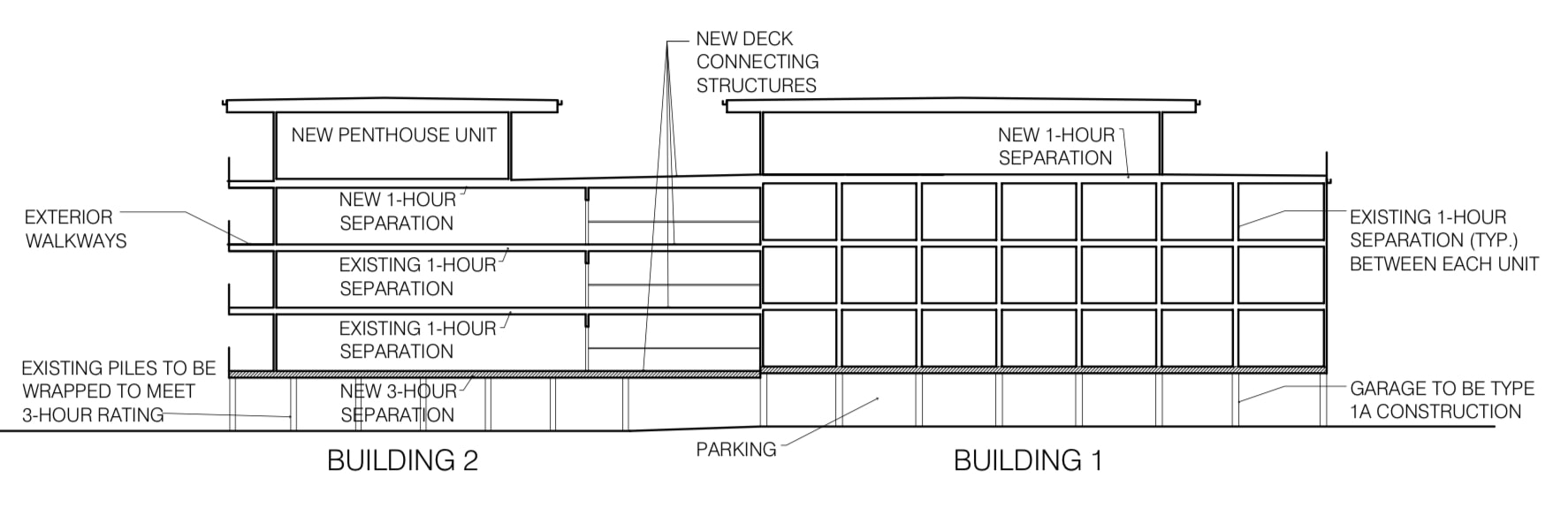
Here is the rundown: the ground level has parking. Above that is a 3-hour horizontal separation between the parking and the first floor. Then there are three stories of apartments above the separation.

I’m looking at this as two separate buildings and am proposing NFPA 13 for the parking and NFPA 13R for the apartments above.
Picture

It will also have two dry standpipes on the exterior stairwells.

My question comes to sprinkler protection on the outside exit corridors and the egress travel distance.

NFPA 13R Section 6.6.5 clearly states that the exit corridors are not required to be protected. Life Safety code allows a means of egress travel distance of 250' for a sprinklered building.

If the building is sprinklered per NFPA 13R with the above ommision, can the 250' egress travel distance be used?

Thought/Comments appreciated!

​
Sent in anonymously for discussion. Click Title to View | Submit Your Question | Subscribe
10 Comments
Pete H
6/20/2023 07:05:33 am

If you're in type v construction, 6.6.5.1 would require protection anyway.

Also, please be advised 6.6.5. changes in 2022 edition to specifically only mean exterior (open) corridors that are not part of a means of egress.

So by 2019 code, yeah, an argument can be made that the code allows an omission for exterior corridors even as a means of egress, but it's the letter of the law and not the spirit of the law as they have altered the letter of the law to stop this in the next available code cycle.

Reply
Pete H
6/20/2023 07:32:27 am

Further on the subject: NFPA 13R 2022 edition also adds 6.6.5.2 which directly says sprinklers shall be provided for exterior corridors and balconies that are part of a means of egress

Reply
Danial Bartle
6/20/2023 08:35:09 am

You do not mention what the height will be or if the "penthouse" is an apartment or a mechanical space. NFPA 13R allows a pedestal design with NFPA 13 used for the base but the height of the building cannot exceed 60 feet if you want to use 13R.

Reply
Jesse
6/20/2023 09:08:02 am

This is one of those weird questions where it depends on the version of NFPA 13 the AHJ has adopted.

In versions prior to 2022, yes you probably can.

Another consideration is the property insurer. All HPR insurers consider themselves to be an additional AHJ. No one would really call this High-Protected Risk of course, but insurers always default to the most recent edition of NFPA 13 while cities and counties are several cycles behind. It may be an occasion where the city approves plans based on 2019 NFPA 13 and the insurer writes is as hydraulically inadequate.

Reply
Dan Wilder
6/20/2023 09:26:03 am

Is the building over 60' tall from the grade plane to even utilize 13R based on the applicable IBC? And verify the floor area increase and other IBC items are being followed to allow 13R?

If so,13R would allow it (depending on edition), but the later intent would suggest against

https://www.meyerfire.com/blog/when-can-i-use-nfpa-13r-part-i

https://nfsa.org/2020/11/17/nfpa-13-vs-nfpa-13r-in-podium-and-mixed-use-construction/

https://www.nfpa.org/News-and-Research/Publications-and-media/Blogs-Landing-Page/NFPA-Today/Blog-Posts/2021/12/14/Fire-Sprinkler-Considerations-for-Podium-Construction

Reply
Kenneth Edwards
6/20/2023 11:24:44 am

We are currently on the 2013 version. Building is 50' tall

Reply
Todd E Wyatt
6/20/2023 12:40:22 pm

An automatic sprinkler system (ASPS) meeting NFPA 13R may not be permitted by the scoping Code (e.g. 2021 IBC) if the Group R Residential Occupancy Classification (OC) is more than four stories above grade plane. The "New Penthouse Unit" needs clarification IF it is a "story" or is a "penthouse".

The stories (01-03, 04 or PH?) require clarification as to what their floor-to-floor heights are to verify that "floor level of the highest story is 30 feet (9144 mm) or less above the lowest level of fire department vehicle access."

Lastly the grade plane needs to be determined to verify that "the floor level of the lowest story is 30 feet (9144 mm) or less below the lowest level of fire department vehicle access" and to determine if the "number of stories of Group R occupancies constructed in accordance with Sections 510.2 and 510.4 shall be measured from grade plane."

Reply
Todd E Wyatt
6/20/2023 01:19:28 pm

After re-reviewing the building section provided, it indicates (1) story of Group S-2 Storage (Parking Garage) + (3) stories of Group R-2 Residential (Apartments) + (1) "New Penthouse Unit" level (Story or PH?).

I should have stated that the "stories (01-04, 05 or PH?) in my initial resopnse.

This may not meet the Conditions 1 (Four stories or fewer above grade plane) of "2021 IBC 903.3.1.2 NFPA 13R Sprinkler Systems" depending where the Grade Plane is determined.

Reply
Todd E Wyatt
6/20/2023 12:41:50 pm

REFERENCES
2021 IBC

Chapter 2 Definitions
STORY. That portion of a building included between the upper surface of a floor and the upper surface of the floor or roof next above (see "Basement," "Building height," "Grade plane" and "Mezzanine"). A story is measured as the vertical distance from top to top of two successive tiers of beams or finished floor surfaces and, for the topmost story, from the top of the floor finish to the top of the ceiling joists or, where there is not a ceiling, to the top of the roof rafters.

STORY ABOVE GRADE PLANE. Any story having its finished floor surface entirely above grade plane, or in which the finished surface of the floor next above is:
1. More than 6 feet (1829 mm) above grade plane; or
2. More than 12 feet (3658 mm) above the finished ground level at any point.
PENTHOUSE. An enclosed, unoccupied rooftop structure used for sheltering mechanical and electrical equipment, tanks, elevators and related machinery, stairways, and vertical shaft openings.

Chapter 9 Fire Protection and Life Safety Systems
Section 903 Automatic Sprinkler Systems

903.3 Installation Requirements
Automatic sprinkler systems shall be designed and installed in accordance with Sections 903.3.1 through 903.3.8.

903.3.1 Standards
Sprinkler systems shall be designed and installed in accordance with Section 903.3.1.1 unless otherwise permitted by Sections 903.3.1.2 and 903.3.1.3 and other chapters of this code, as applicable.

903.3.1.2 NFPA 13R Sprinkler Systems
Automatic sprinkler systems in Group R occupancies shall be permitted to be installed throughout in accordance with NFPA 13R where the Group R occupancy meets ALL of the following conditions:
1. Four stories or fewer above grade plane.
2. The floor level of the highest story is 30 feet (9144 mm) or less above the lowest level of fire department vehicle access.
3. The floor level of the lowest story is 30 feet (9144 mm) or less below the lowest level of fire department vehicle access.
4. The number of stories of Group R occupancies constructed in accordance with Sections 510.2 and 510.4 shall be measured from grade plane.
903.3.1.2.1 Balconies and Decks
Sprinkler protection shall be provided for exterior balconies, decks and ground floor patios of dwelling units and sleeping units where either of the following conditions exists:
1. The building is of Type V construction, provided that there is a roof or deck above.
2. Exterior balconies, decks and ground floor patios of dwelling units and sleeping units are constructed in accordance with Section 705.2.3.1, Exception 3.
3. Sidewall sprinklers that are used to protect such areas shall be permitted to be located such that their deflectors are within 1 inch (25 mm) to 6 inches (152 mm) below the structural members and a maximum distance of 14 inches (356 mm) below the deck of the exterior balconies and decks that are constructed of open wood joist construction.
903.3.1.2.2 Corridors and Balconies in the Means of Egress
Sprinkler protection shall be provided in corridors and for balconies in the means of egress where any of the following conditions apply:
1. Corridors with combustible floor or walls.
2. Corridors with an interior change of direction exceeding 45 degrees (0.79 rad).
3. Corridors that are less than 50 percent open to the outside atmosphere at the ends.
4. Open-ended corridors and associated exterior stairways and ramps as specified in Section 1027.6, Exception 3.
5. Egress balconies not complying with Sections 1021.2 and 1021.3.

Reply
Todd E Wyatt
6/20/2023 12:45:17 pm

Chapter 5 General Building Heights and Areas
Section 510 Special Provisions
510.1 General
The provisions in Sections 510.2 through 510.9 shall permit the use of special conditions that are exempt from, or modify, the specific requirements of this chapter regarding the allowable building heights and areas of buildings based on the occupancy classification and type of construction, provided the special condition complies with the provisions specified in this section for such condition and other applicable requirements of this code. The provisions of Sections 510.2 through 510.8 are to be considered independent and separate from each other.

510.2 Horizontal Building Separation Allowance
A building shall be considered as separate and distinct buildings for the purpose of determining area limitations, continuity of fire walls, limitation of number of stories and type of construction where the following conditions are met:
1. The buildings are separated with a horizontal assembly having a fire-resistance rating of not less than 3 hours. Where vertical offsets are provided as part of a horizontal assembly, the vertical offset and the structure supporting the vertical offset shall have a fire-resistance rating of not less than 3 hours.
2. The building below, including the horizontal assembly, is of Type IA construction.
3. Shaft, stairway, ramp and escalator enclosures through the horizontal assembly shall have not less than a 2-hour fire-resistance rating with opening protectives in accordance with Section 716.
Exception: Where the enclosure walls below the horizontal assembly have not less than a 3-hour fire-resistance rating with opening protectives in accordance with Section 716, the enclosure walls extending above the horizontal assembly shall be permitted to have a 1-hour fire-resistance rating, provided that the following conditions are met:
1. The building above the horizontal assembly is not required to be of Type I construction.
2. The enclosure connects fewer than four stories.
3. The enclosure opening protectives above the horizontal assembly have a fire protection rating of not less than 1 hour.

4. Interior exit stairways located within the Type IA building are permitted to be of combustible materials where the following requirements are met:
4.1. The building above the Type IA building is of Type III, IV, or V construction.
4.2. The stairway located in the Type IA building is enclosed by 3-hour fire-resistance-rated construction with opening protectives in accordance with Section 716.
5. The building or buildings above the horizontal assembly shall be permitted to have multiple Group A occupancy uses, each with an occupant load of less 300, or Group B, M, R or S occupancies.
6. The building below the horizontal assembly shall be protected throughout by an approved automatic sprinkler system in accordance with Section 903.3.1.1, and shall be permitted to be any occupancy allowed by this code except Group H.
7. The maximum building height in feet (mm) shall not exceed the limits set forth in Section 504.3 for the building having the smaller allowable height as measured from the grade plane.
510.4 Parking Beneath Group R
Where a maximum one story above grade plane Group S-2 parking garage, enclosed or open, or combination thereof, of Type I construction or open of Type IV construction, with grade entrance, is provided under a building of Group R, the number of stories to be used in determining the minimum type of construction shall be measured from the floor above such a parking area. The floor assembly between the parking garage and the Group R above shall comply with the type of construction required for the parking garage and shall also provide a fire-resistance rating not less than the mixed occupancy separation required in Section 508.4.

Reply


Leave a Reply.

    SUBMIT A QUESTION
    Picture
    Why Sponsor?

    ALL-ACCESS

    Picture
    GET ALL OUR TOOLS

    SUBSCRIBE

    Subscribe and learn something new each day:
    I'm Interested In:

    COMMUNITY

    Top Oct '25 Contributors
    Picture
    Picture
    Picture
    Picture
    Picture
    Picture
    Picture
    Picture
    Picture
    Picture
    SEE LEADERBOARD

    YOUR POST

    SUBMIT A QUESTION

    PE EXAM

    Get 100 Days of Free Sample Questions right to you!
    SIGN ME UP!

    FILTERS

    All
    A1171
    ABA
    ADA
    ASCE 7
    ASME A17.1
    ASTM E1354
    Blog Thread
    Daily Discussion
    Design-documents
    EN 12259-1
    EN 12845
    Explosion Protection
    Explosion-protection-prevention
    Fire Detection And Alarm Systems
    Fire Dynamics
    Flammable And Combustible Liquids
    Flammable-combustible-liquids
    FM Global
    Human-behavior
    IBC
    ICC 500
    IEBC
    IFC
    IMC
    IPC
    IRC
    ISO
    Means Of Egress
    NBC
    NFPA 1
    NFPA 10
    NFPA 101
    NFPA 11
    NFPA 110
    NFPA 1142
    NFPA 1221
    NFPA 13
    NFPA 13D
    NFPA 13R
    NFPA 14
    NFPA 15
    NFPA 16
    NFPA 17A
    NFPA 20
    NFPA 2001
    NFPA 214
    NFPA 22
    NFPA 220
    NFPA 24
    NFPA 241
    NFPA 25
    NFPA 291
    NFPA 30
    NFPA 307
    NFPA 30B
    NFPA 31
    NFPA 33
    NFPA 37
    NFPA 400
    Nfpa-409
    Nfpa-415
    Nfpa-45
    Nfpa-495
    NFPA 497
    NFPA 5000
    NFPA 502
    NFPA 54
    NFPA 55
    NFPA 654
    NFPA 68
    NFPA 70
    NFPA 701
    NFPA 72
    NFPA 75
    NFPA 770
    NFPA 82
    NFPA 850
    NFPA 855
    NFPA 90A
    NFPA 92
    NFPA 96
    NICET
    OBC
    OSHA
    Passive Building Systems
    PE Prep Guide
    PE Prep Series
    PE Sample Problems
    Poll
    Smoke Management
    Special Hazard Systems
    UFC 3-600-01
    UFC 4-021-01
    UFC 4-211-01
    UPC
    Updates
    Water Based Fire Suppression
    Weekly Exams


    ARCHIVES

    November 2025
    October 2025
    September 2025
    August 2025
    July 2025
    June 2025
    May 2025
    April 2025
    March 2025
    February 2025
    January 2025
    December 2024
    November 2024
    October 2024
    September 2024
    August 2024
    July 2024
    June 2024
    May 2024
    April 2024
    March 2024
    February 2024
    January 2024
    December 2023
    November 2023
    October 2023
    September 2023
    August 2023
    July 2023
    June 2023
    May 2023
    April 2023
    March 2023
    February 2023
    January 2023
    December 2022
    November 2022
    October 2022
    September 2022
    August 2022
    July 2022
    June 2022
    May 2022
    April 2022
    March 2022
    February 2022
    January 2022
    December 2021
    November 2021
    October 2021
    September 2021
    August 2021
    July 2021
    June 2021
    May 2021
    April 2021
    March 2021
    February 2021
    January 2021
    December 2020
    November 2020
    October 2020
    September 2020
    August 2020
    July 2020
    June 2020
    May 2020
    April 2020
    March 2020
    February 2020
    January 2020
    December 2019
    November 2019
    October 2019
    September 2019
    August 2019
    July 2019
    June 2019
    May 2019
    April 2019
    March 2019
    February 2019
    January 2019
    December 2018
    November 2018
    October 2018
    September 2018
    August 2018
    July 2018
    June 2018
    May 2018
    November 2017
    October 2017
    September 2017
    August 2017
    July 2017
    June 2017
    November 2016
    October 2016
    July 2016
    June 2016


    PE PREP SERIES

    SEE LEADERBOARD

    RSS Feed

Picture
​Home
Our Cause
The Blog
The Forum
PE Exam Prep
The Toolkit

MeyerFire University
​Pricing
Login
​Support
Contact Us
Picture

MeyerFire.com is a startup community built to help fire protection professionals shine.
Our goal is to improve fire protection practices worldwide. We promote the industry by creating helpful tools and resources, and by bringing together industry professionals to share their expertise.

​MeyerFire, LLC is a NICET Recognized Training Provider and International Code Council Preferred Education Provider.

All text, images, and media ​Copyright © 2016-2025 MeyerFire, LLC

We respect your privacy and personal data. See our Privacy Policy and Terms of Service. 
The views, opinions, and information found on this site represent solely the author and do not represent the opinions of any other party, nor does the presented material assume responsibility for its use. Fire protection and life safety systems constitute a critical component for public health and safety and you should consult with a licensed professional for proper design and code adherence.

Discussions are solely for the purpose of peer review and the exchange of ideas. All comments are reviewed. Comments which do not contribute, are not relevant, are spam, or are disrespectful in nature may be removed. Information presented and opinions expressed should not be relied upon as a replacement for consulting services. Some (not all) outbound links on this website, such as Amazon links, are affiliate-based where we receive a small commission for orders placed elsewhere.

  • Blog
  • Forum
  • TOOLKIT
    • ALL TOOLS
    • BUY THE TOOLKIT
  • UNIVERSITY
    • ALL COURSES
    • JOIN THE UNIVERSITY
  • PE Exam
    • PE Forum & Errata
    • PE Store
    • PE Tools
    • PE PREP SERIES
    • PE 100-Day Marathon
  • LOGIN
    • TOOLKIT-ONLY LOGIN
    • UNIVERSITY LOGIN
  • STORE
  • OUR CAUSE
    • ABOUT MEYERFIRE
    • JOB OPENINGS
    • BECOME AN INSTRUCTOR
    • HELP/SUPPORT