
MeyerFire
  • Blog
  • Forum
  • TOOLKIT
    • ALL TOOLS
    • BUY THE TOOLKIT
  • UNIVERSITY
    • ALL COURSES
    • JOIN THE UNIVERSITY
  • PE Exam
    • PE Forum & Errata
    • PE Store
    • PE Tools
    • PE PREP SERIES
    • PE Old Questions
  • LOGIN
    • TOOLKIT-ONLY LOGIN
    • UNIVERSITY LOGIN
  • STORE
  • OUR CAUSE
    • ABOUT MEYERFIRE
    • JOB OPENINGS
    • BECOME AN INSTRUCTOR
    • HELP/SUPPORT
Picture

Sprinkler Main OK to Hang from Wood Trapeze?

2/2/2024

14 Comments

 
We have a new construction building that's wood frame (Type III-B), and we have an 8-inch horizontal standpipe. It's hung from wooden trapeze (two 2x4's) spanning wood floor trusses.
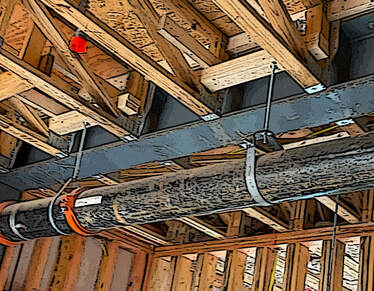
Picture
Per NFPA 13-2019 Section 17.1.7.1, hangers and their components shall be ferrous metal.

Is a ferrous metal trapeze (steel angle or pipe span) permitted to span wood floor trusses?

If so, must the trapeze avoid attaching to the web components of the truss?

Thanks in advance.

​​​​​​​​​​​​​​​​​​​​​​​​​Sent in anonymously for discussion. Click Title to View | Submit Your Question | Subscribe
14 Comments
Anthony
2/2/2024 07:20:51 am

First off obvious answer that'll to just hang of that I beam in that photo and move on.

Wood is not given in the prescriptive methods for constructing a trapeze in NFPA CH 9 so that's out.

The next argument is that all hangers must go to structure. Can you hang to a wood structure? Yes you can. Is adding (2) 2x4's spanning the bottom cord of 2 open web wood joists considered a structural member? Ehh, probably not.

This will go back to NFPA 13-16 9.2.1.3.1:

Sprinkler piping shall be substantially supported from the building structure, which must support the added load of the water-filled pipe plus a minimum of 250 lb (115 kg) applied at the point of hanging, except where permitted by 9.2.1.1.2, 9.2.1.3.3, and 9.2.1.4.1.


The annex goes one to say:

A.9.2.1.3 The method used to attach the hanger to the structure and the load placed on the hanger should take into account any limits imposed by the structure.

The building structure is only required to handle the
weight of the water-filled pipe and components, while the
hangers are required to handle 5 times the weight of the
water-filled pipe. In addition, a safety factor load of 250 lb
(114 kg) is added in both cases. The difference in requirements has to do with the different ways that loads are calculated and safety factors are applied.


In summery if the structure can't support your pipe you need to hang somewhere it can or reenforce the building. It is implied that only a structural engineer can approve changes and alterations to a structure to allow for such loads. So yeah you're going to need to run by the structural engineer how often you need place your trapezes and where.

Reply
Dan Wilder
2/2/2024 07:39:57 am

The AWC provides section modulus values for sawn lumber but it's based on a distributed load not single point (that I can find readily). Unfortunately, not only did they use a 2x in the worst orientation, even if it is doubled up, with shorter spans, and it looks like they did a through connection with washers & nuts, this really needs to be signed off by the truss structural engineer and the building structural engineer.

The lower plate connector needs to be reinforced to avoid it from ripping apart, the truss hanger needs to be evaluated for the additional load, the upper connection from the truss to the beam also needs to be reviewed for its weight capacity and the overall dead load for the floor above should be recalculated for this span. I would have rather seen pipe vs lumber in this case and using that beefy steel beam lower flange (or notch the upper plate to get a good TBC bite into the upper flange.

17.3.5 only says the components of each trapeze member that attach to the trapeze shall be listed, the trapeze is part of the structure so it can be of any material once confirmed for weight capacity.

Reply
Jesse
2/2/2024 08:15:52 am

I'd love to know more about why they ran dimensional lumber that way...

Good question to think about, but I admit I'm having difficulty getting beyond the lumber.13 directs us to ensure hat all components of the trapeze be listed material.

Reply
Mike F
2/2/2024 08:17:44 am

Dan W. Is right on with the answer. Question with the steel I Beam so close, why did they not hang right from the steel shown in the picture

Reply
Chad
2/2/2024 08:18:56 am

100% argree.. you need a PE ok that added load to an engineered truss, there is no truss manufacturer that ok’s significant loads like that on their spec sheets…. Especially to the bottom chord.

Or move it to the steel and it’s good.

Reply
Josh
2/2/2024 08:59:58 am

The ultimate irony of the decision is the beam not only appearing in the same picture, but being right next to it.

Reply
DAN
2/2/2024 09:34:52 am

Plus- the traps should be supported from the top cord pf the truss...not the bottom

Reply
Rlujan
2/2/2024 09:42:58 am

My guess is they offset from the beam to allow the pipe, which looks to be six in., to pass the column without adding extra fittings.

Reply
Jack G
2/2/2024 09:53:24 am

#1- are the floor joists rated for mechanical load.
Probably not. The engineer might spec the right joist but the contractor/ truss manufacturer provides a cheaper less supportive truss.
Never hang from the bottom. Truss manufacturer will provide details and weight loads.
And like everyone says -- hang to the beam .

Reply
Dave
2/2/2024 10:43:11 am

There’s some relevant commentary in the NFPA #13 handbook, but it basically says, “where materials other than steel are proposed for trapeze members, an engineering analysis must be completed to determine the material’s capability.” You can’t go by gut-feel; the building designer has the option to modify the structure. As Jack says, consult the truss manufacturer’s guidelines and details (in our neck of the woods it is usually Red-Built / old TJI). If suspending the top chord, remember one must have enough meat below the attachment point, plus per NFPA 13 each individual component of the trap must be sized for the 8-in. pipe being supported.

Reply
Pete H
2/2/2024 01:09:25 pm

The beam is right there. Put a beam clamp on the rod and stop hanging from the wood trapeze.

Reply
sean
2/4/2024 09:28:03 am

this photo is so wrong. hanging from the bottom of a truss/joist shouldn't be done unless prescribed by the engineer.

Reply
Janakkumar B. Patel link
2/7/2024 02:40:02 pm

The ferrous hanger components (Listed pipe clamp and ferrous threaded rod meet NFPA 13 requirements. The wooden beam needs to be calculated and certified by a Registered Professional Engineer.

NFPA 13 (2019), Section 17.1.2(4) states: "Hanger components shall be ferrous."
NFPA 13 (2019), Section 17.1.7.2 states: "Nonferrous components that have been proven by fire tests to be adequate for the hazard application, that are listed for this purpose, and that are in compliance with the other requirements of this section shall be acceptable.

So, the wooden beam used for supporting the hanger shall comply with not only the design load of 'w+250' lb., but also NFPA 13 (2019), Section 17.1.7.2. Also, see NFPA 13, Sections 17.5.2.2, 18.5.3.2.

janak patel
NFPA 13.

Reply
Chris
2/8/2024 08:58:22 am

You are allowed to hang from wood structure but technically it is only considered wood structure if the framers were the ones that put it there IIRC, you are not to add wood yourself to hang from. If you cant hang off the H beam in the photo I would say you will need to install a steel member for the trapeze to the top cord of the truss, a piece of angle iron or unistrut may be easiest.

Reply


Leave a Reply.

    SUBMIT A QUESTION
    Picture
    Why Sponsor?

    ALL-ACCESS

    Picture
    GET ALL OUR TOOLS

    SUBSCRIBE

    Subscribe and learn something new each day:
    I'm Interested In:

    COMMUNITY

    Top Feb '26 Contributors
    Picture
    Picture
    Picture
    Picture
    Picture
    Picture
    Picture
    Picture
    Picture
    Picture
    SEE LEADERBOARD

    YOUR POST

    SUBMIT A QUESTION

    PE EXAM

    Get 100 Days of Free Sample Questions right to you!
    SIGN ME UP!

    FILTERS

    All
    A1171
    ABA
    ADA
    ASCE 7
    ASME A17.1
    ASTM E1354
    Blog Thread
    Daily Discussion
    Design-documents
    EN 12259-1
    EN 12845
    Explosion Protection
    Explosion-protection-prevention
    Fire Detection And Alarm Systems
    Fire Dynamics
    Flammable And Combustible Liquids
    Flammable-combustible-liquids
    FM Global
    Human-behavior
    IBC
    ICC 500
    IEBC
    IFC
    IMC
    IPC
    IRC
    ISO
    Means Of Egress
    NBC
    NFPA 1
    NFPA 10
    NFPA 101
    NFPA 11
    NFPA 110
    NFPA 1142
    NFPA 1221
    NFPA 13
    NFPA 13D
    NFPA 13R
    NFPA 14
    NFPA 15
    NFPA 16
    NFPA 17A
    NFPA 20
    NFPA 2001
    NFPA 214
    NFPA 22
    NFPA 220
    NFPA 24
    NFPA 241
    NFPA 25
    NFPA 291
    NFPA 30
    NFPA 307
    NFPA 30B
    NFPA 31
    NFPA 33
    NFPA 37
    NFPA 400
    Nfpa-409
    Nfpa-415
    Nfpa-45
    Nfpa-495
    NFPA 497
    NFPA 5000
    NFPA 502
    NFPA 54
    NFPA 55
    NFPA 654
    NFPA 68
    NFPA 70
    NFPA 701
    NFPA 72
    NFPA 75
    NFPA 770
    NFPA 82
    NFPA 850
    NFPA 855
    NFPA 90A
    NFPA 92
    NFPA 96
    NICET
    OBC
    OSHA
    Passive Building Systems
    PE Prep Guide
    PE Prep Series
    PE Sample Problems
    Poll
    Smoke Management
    Special Hazard Systems
    UFC 3-600-01
    UFC 4-021-01
    UFC 4-211-01
    UPC
    Updates
    Water Based Fire Suppression
    Weekly Exams


    ARCHIVES

    March 2026
    February 2026
    January 2026
    December 2025
    November 2025
    October 2025
    September 2025
    August 2025
    July 2025
    June 2025
    May 2025
    April 2025
    March 2025
    February 2025
    January 2025
    December 2024
    November 2024
    October 2024
    September 2024
    August 2024
    July 2024
    June 2024
    May 2024
    April 2024
    March 2024
    February 2024
    January 2024
    December 2023
    November 2023
    October 2023
    September 2023
    August 2023
    July 2023
    June 2023
    May 2023
    April 2023
    March 2023
    February 2023
    January 2023
    December 2022
    November 2022
    October 2022
    September 2022
    August 2022
    July 2022
    June 2022
    May 2022
    April 2022
    March 2022
    February 2022
    January 2022
    December 2021
    November 2021
    October 2021
    September 2021
    August 2021
    July 2021
    June 2021
    May 2021
    April 2021
    March 2021
    February 2021
    January 2021
    December 2020
    November 2020
    October 2020
    September 2020
    August 2020
    July 2020
    June 2020
    May 2020
    April 2020
    March 2020
    February 2020
    January 2020
    December 2019
    November 2019
    October 2019
    September 2019
    August 2019
    July 2019
    June 2019
    May 2019
    April 2019
    March 2019
    February 2019
    January 2019
    December 2018
    November 2018
    October 2018
    September 2018
    August 2018
    July 2018
    June 2018
    May 2018
    November 2017
    October 2017
    September 2017
    August 2017
    July 2017
    June 2017
    November 2016
    October 2016
    July 2016
    June 2016


    PE PREP SERIES

    SEE LEADERBOARD

    SEARCH THE FORUM

    RSS Feed

Picture
​Home
Our Cause
The Blog
The Forum
PE Exam Prep
The Toolkit

MeyerFire University
​Pricing
Login
​Support
Contact Us
Picture

MeyerFire.com is a startup community built to help fire protection professionals shine.
Our goal is to improve fire protection practices worldwide. We promote the industry by creating helpful tools and resources, and by bringing together industry professionals to share their expertise.

​MeyerFire, LLC is a NICET Recognized Training Provider and International Code Council Preferred Education Provider.

All text, images, and media ​Copyright © 2016-2025 MeyerFire, LLC

We respect your privacy and personal data. See our Privacy Policy and Terms of Service. 
The views, opinions, and information found on this site represent solely the author and do not represent the opinions of any other party, nor does the presented material assume responsibility for its use. Fire protection and life safety systems constitute a critical component for public health and safety and you should consult with a licensed professional for proper design and code adherence.

Discussions are solely for the purpose of peer review and the exchange of ideas. All comments are reviewed. Comments which do not contribute, are not relevant, are spam, or are disrespectful in nature may be removed. Information presented and opinions expressed should not be relied upon as a replacement for consulting services. Some (not all) outbound links on this website, such as Amazon links, are affiliate-based where we receive a small commission for orders placed elsewhere.

  • Blog
  • Forum
  • TOOLKIT
    • ALL TOOLS
    • BUY THE TOOLKIT
  • UNIVERSITY
    • ALL COURSES
    • JOIN THE UNIVERSITY
  • PE Exam
    • PE Forum & Errata
    • PE Store
    • PE Tools
    • PE PREP SERIES
    • PE Old Questions
  • LOGIN
    • TOOLKIT-ONLY LOGIN
    • UNIVERSITY LOGIN
  • STORE
  • OUR CAUSE
    • ABOUT MEYERFIRE
    • JOB OPENINGS
    • BECOME AN INSTRUCTOR
    • HELP/SUPPORT