
MeyerFire
  • Blog
  • Forum
  • TOOLKIT
    • ALL TOOLS
    • BUY THE TOOLKIT
  • UNIVERSITY
    • ALL COURSES
    • JOIN THE UNIVERSITY
  • PE Exam
    • PE Forum & Errata
    • PE Store
    • PE Tools
    • PE PREP SERIES
    • PE Old Questions
  • LOGIN
    • TOOLKIT-ONLY LOGIN
    • UNIVERSITY LOGIN
  • STORE
  • OUR CAUSE
    • ABOUT MEYERFIRE
    • JOB OPENINGS
    • BECOME AN INSTRUCTOR
    • HELP/SUPPORT
Picture

Specific Location for the Fire Pump Test Header?

2/16/2024

13 Comments

 
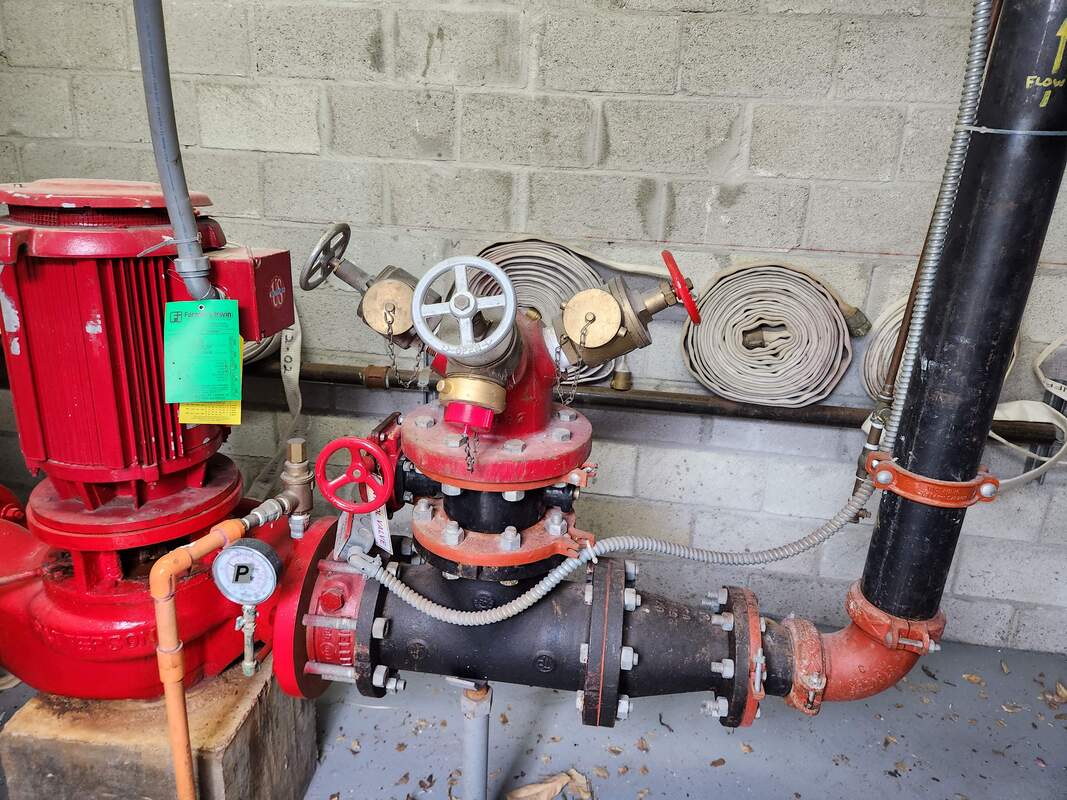
Is there a specific location requirement for a fire pump test header?

NFPA 20 states that the header must be installed on the exterior wall, and outside the fire pump room.

Does this mean that the test header cannot be installed in the fire pump room?

Additionally, can the test header be directly connected to the pump discharge flange as shown in this photo?
Picture
I have never seen this type of installation before. Thanks in advance.

​​​​​​​​​​​​​​​​​​​​​​​​​Sent in anonymously for discussion. Click Title to View | Submit Your Question | Subscribe
13 Comments
Glenn Berger
2/16/2024 08:20:16 am

Looks like either a retrofit or a OHGEE installation.

I have been forced to do projects where the test header is installed indoors and the testing will require great care in securing the hoses in place.

I do not like seeing hoses "stored" by the fire pump. I can guarantee that these hoses will not be properly inspected or tested before they are hooked up to be used.

Reply
Scott McCormick
2/16/2024 08:20:45 am

I have seen a new installation in an old school that had a single hose valve inside the room, this room was below grade but had an exterior door and stairway that led to grade. I was not happy with this however it would have taken major structural work to get this test header to grade.

Reply
Casey Milhorn
2/16/2024 08:26:11 am

I don't know of anything in NFPA 20 that says you can't do this and in fact we have done this before in rare cases.

I second not using those stored hoses... but if the facility is doing their own testing an a regular basis, then that's on them.

I hope there is a control valve somewhere downstream. I would have expected it to be immediately after the tee for the test header. But I do see the sensing line connection on the vertical pipe and the control valve should be downstream of that somewhere.

Reply
Sean
2/16/2024 08:31:58 am

From NFPA 22 (2022), see the commentary below. The indoor installation can be used if approved by the AHJ in certain situations, but preferrable to locate outdoors to prevent water spray on the pump electrical equipment from loose hose valve connections.

A.4.22.1.5
The hose valves of the fire pump test header should be located on the building exterior. This is because the test discharge needs to be directed to a safe outdoor location, and to protect the fire pumps, controllers, and so forth, from accidental water spray. In instances where damage from theft or vandalism is a concern, the test header hose valves can be located within the building but outside of the fire pump room if, in the judgment of the authority having jurisdiction, the test flow can be safely directed outside the building without undue risk of water spray to the fire pump equipment.

Reply
Jesse
2/16/2024 08:36:40 am

I'm wondering if the pump was installed as a retrofit.

This arrangement isn't ideal for sure. But the purpose of the test header to to test the performance of the pump and while this installation isn't ideal, it serves the function.

Reply
Dan Wilder
2/16/2024 08:40:40 am

The whole reason to have the test header outside is to protect the equipment during water discharge, well (I hope) more the people from that tingly feeling when the humming equipment gets wet. This installation should not be allowed per 20-20 4.22.15 however, that requirement was new as of the 2010 Edition (Section 4.20.1.4) so anything prior would technically be acceptable.

Its "supply" location is after the wafer check (even if those bolts or ATR isn't fully engaging the nut for the #7-#8 locations in the pic) is acceptable but it should be piped to another location for the actual test header.

I'm hoping that is a bad angle on the pic or it's an eccentric reducer (installed flat face down) before the Ell on the right then the sensing line on the vertical pipe via a mech tee. All correct for locations.

Reply
Greg
2/16/2024 08:42:26 am

While this may not be the case with this installation, theft of brass pump test header appliances is a real thing in some regions. My first thought after 'retrofit savings' was one of 'theft deterrence'

Reply
Greg
2/16/2024 08:47:56 am

BTW, did anyone notice the wood box supporting the electric pump ?

Shout out to on the comment by Dan on 'danger close' high voltage AC within inches of the metal handle water assembly and spurious leak that always needs the extra spanner tightening.

"How about them apples.. "

Reply
Dan Wilder
2/16/2024 09:20:39 am

It looks like rusted over concrete...

The unused pipe stand and the partially engaged nuts on the discharge flange (bolts #7 & #8) could be an easy cleanup fix...it's the little things.

And that 2½x1½ adapter cap looks like a maintenance guys way of cleaning off areas with that 1½" hose on the wall in the background left side from '02.

Jack G
2/16/2024 12:45:36 pm

First of all— this appears to be a Patterson 750 gpm fire pump vertical inline.
3 test valves are mounted on the tee with a control valve.
There appears to be a wafer check sandwiched between the pump discharge flange and the test headers flanged tee.

In the thousands of pump tests I ve performed , thru the years, mounting the wafer check to the flange could affect the test by 3-5 psi or more,( the way shown ) as opposed to mounting an 8 inch long “ straightening” pipe on the fire pump discharge.
This would affect the performance test. Especially if a lower psi boost .

Looks like a kunkle casing relief, discharging into plastic pipe. Bad idea, could snap and be propelled across the room.

The pad appears to be concrete with grout poured over the pad to cover the bolts. Some rust on it too.

This may be a newer installation as the pump bowl is not rusted with rusty water flowing over the bowl, pad, to the floor from drip fittings—— or—- the packing of the drip valves was so worn, ( excess water discharging) the valves may be turned off ( very bad idea )

If a 750 Patterson inline — one of the best features is the casing is accessible thru plugs to clear rocks from casing, as opposed to removing the motor for access to do the same.
I used to paint the casing and bowl with epoxy paint for the rust problem that all the VIP pumps have. Factory was 1500 bucks, shop- 50 bucks for the paint.

The test header has 2 different type angle hose valves, one with an adapter, maybe 2.5 x 1.5, for cleaning purposes, 1.5 hose on floor. ( bad idea) alarms could go off( opening th valve, or pump could trigger ( if pump, up, settings are set per NFA. 20 )

Looks like a concentric reducer to the ell to the sensing line and to a discharge control valve. Bad camera angle.
Can’t see where the jp is connected. Hopefully it’s correct. And set up properly.

Reply
Ryan Hinson
2/16/2024 02:11:02 pm

Per the wafer swing check mfgrs literature, it should not be installed so the open clapper partially obstructs flow into vertical tee outlet to the test header. Expect an indicated drop in test performance as indicated previously.

Reply
Dan Hartel
2/21/2024 09:02:11 am

I've done this before on small pumps (500 gpm and smaller) when there's a short and straight shot through a door to the outside.

Reply
Mary E Marley
2/21/2024 11:48:42 am

I was never a fan of testing pumps with inside headers for safety concerns. Not only does the person working the valves have limited options to get away, you also need to go back and forth past the header to get the suction, discharge and speed readings. Also, the header is very close to the pump and turbulence would likely impact the test results.

Reply


Leave a Reply.

    SUBMIT A QUESTION
    Picture
    Why Sponsor?

    ALL-ACCESS

    Picture
    GET ALL OUR TOOLS

    SUBSCRIBE

    Subscribe and learn something new each day:
    I'm Interested In:

    COMMUNITY

    Top Dec '25 Contributors
    Picture
    Picture
    Picture
    Picture
    Picture
    Picture
    Picture
    Picture
    Picture
    Picture
    SEE LEADERBOARD

    YOUR POST

    SUBMIT A QUESTION

    PE EXAM

    Get 100 Days of Free Sample Questions right to you!
    SIGN ME UP!

    FILTERS

    All
    A1171
    ABA
    ADA
    ASCE 7
    ASME A17.1
    ASTM E1354
    Blog Thread
    Daily Discussion
    Design-documents
    EN 12259-1
    EN 12845
    Explosion Protection
    Explosion-protection-prevention
    Fire Detection And Alarm Systems
    Fire Dynamics
    Flammable And Combustible Liquids
    Flammable-combustible-liquids
    FM Global
    Human-behavior
    IBC
    ICC 500
    IEBC
    IFC
    IMC
    IPC
    IRC
    ISO
    Means Of Egress
    NBC
    NFPA 1
    NFPA 10
    NFPA 101
    NFPA 11
    NFPA 110
    NFPA 1142
    NFPA 1221
    NFPA 13
    NFPA 13D
    NFPA 13R
    NFPA 14
    NFPA 15
    NFPA 16
    NFPA 17A
    NFPA 20
    NFPA 2001
    NFPA 214
    NFPA 22
    NFPA 220
    NFPA 24
    NFPA 241
    NFPA 25
    NFPA 291
    NFPA 30
    NFPA 307
    NFPA 30B
    NFPA 31
    NFPA 33
    NFPA 37
    NFPA 400
    Nfpa-409
    Nfpa-415
    Nfpa-45
    Nfpa-495
    NFPA 497
    NFPA 5000
    NFPA 502
    NFPA 54
    NFPA 55
    NFPA 654
    NFPA 68
    NFPA 70
    NFPA 701
    NFPA 72
    NFPA 75
    NFPA 770
    NFPA 82
    NFPA 850
    NFPA 855
    NFPA 90A
    NFPA 92
    NFPA 96
    NICET
    OBC
    OSHA
    Passive Building Systems
    PE Prep Guide
    PE Prep Series
    PE Sample Problems
    Poll
    Smoke Management
    Special Hazard Systems
    UFC 3-600-01
    UFC 4-021-01
    UFC 4-211-01
    UPC
    Updates
    Water Based Fire Suppression
    Weekly Exams


    ARCHIVES

    February 2026
    January 2026
    December 2025
    November 2025
    October 2025
    September 2025
    August 2025
    July 2025
    June 2025
    May 2025
    April 2025
    March 2025
    February 2025
    January 2025
    December 2024
    November 2024
    October 2024
    September 2024
    August 2024
    July 2024
    June 2024
    May 2024
    April 2024
    March 2024
    February 2024
    January 2024
    December 2023
    November 2023
    October 2023
    September 2023
    August 2023
    July 2023
    June 2023
    May 2023
    April 2023
    March 2023
    February 2023
    January 2023
    December 2022
    November 2022
    October 2022
    September 2022
    August 2022
    July 2022
    June 2022
    May 2022
    April 2022
    March 2022
    February 2022
    January 2022
    December 2021
    November 2021
    October 2021
    September 2021
    August 2021
    July 2021
    June 2021
    May 2021
    April 2021
    March 2021
    February 2021
    January 2021
    December 2020
    November 2020
    October 2020
    September 2020
    August 2020
    July 2020
    June 2020
    May 2020
    April 2020
    March 2020
    February 2020
    January 2020
    December 2019
    November 2019
    October 2019
    September 2019
    August 2019
    July 2019
    June 2019
    May 2019
    April 2019
    March 2019
    February 2019
    January 2019
    December 2018
    November 2018
    October 2018
    September 2018
    August 2018
    July 2018
    June 2018
    May 2018
    November 2017
    October 2017
    September 2017
    August 2017
    July 2017
    June 2017
    November 2016
    October 2016
    July 2016
    June 2016


    PE PREP SERIES

    SEE LEADERBOARD

    SEARCH THE FORUM

    RSS Feed

Picture
​Home
Our Cause
The Blog
The Forum
PE Exam Prep
The Toolkit

MeyerFire University
​Pricing
Login
​Support
Contact Us
Picture

MeyerFire.com is a startup community built to help fire protection professionals shine.
Our goal is to improve fire protection practices worldwide. We promote the industry by creating helpful tools and resources, and by bringing together industry professionals to share their expertise.

​MeyerFire, LLC is a NICET Recognized Training Provider and International Code Council Preferred Education Provider.

All text, images, and media ​Copyright © 2016-2025 MeyerFire, LLC

We respect your privacy and personal data. See our Privacy Policy and Terms of Service. 
The views, opinions, and information found on this site represent solely the author and do not represent the opinions of any other party, nor does the presented material assume responsibility for its use. Fire protection and life safety systems constitute a critical component for public health and safety and you should consult with a licensed professional for proper design and code adherence.

Discussions are solely for the purpose of peer review and the exchange of ideas. All comments are reviewed. Comments which do not contribute, are not relevant, are spam, or are disrespectful in nature may be removed. Information presented and opinions expressed should not be relied upon as a replacement for consulting services. Some (not all) outbound links on this website, such as Amazon links, are affiliate-based where we receive a small commission for orders placed elsewhere.

  • Blog
  • Forum
  • TOOLKIT
    • ALL TOOLS
    • BUY THE TOOLKIT
  • UNIVERSITY
    • ALL COURSES
    • JOIN THE UNIVERSITY
  • PE Exam
    • PE Forum & Errata
    • PE Store
    • PE Tools
    • PE PREP SERIES
    • PE Old Questions
  • LOGIN
    • TOOLKIT-ONLY LOGIN
    • UNIVERSITY LOGIN
  • STORE
  • OUR CAUSE
    • ABOUT MEYERFIRE
    • JOB OPENINGS
    • BECOME AN INSTRUCTOR
    • HELP/SUPPORT