
MeyerFire
  • Blog
  • Forum
  • TOOLKIT
    • ALL TOOLS
    • BUY THE TOOLKIT
  • UNIVERSITY
    • ALL COURSES
    • JOIN THE UNIVERSITY
  • PE Exam
    • PE Forum & Errata
    • PE Store
    • PE Tools
    • PE PREP SERIES
    • PE Old Questions
  • LOGIN
    • TOOLKIT-ONLY LOGIN
    • UNIVERSITY LOGIN
  • STORE
  • OUR CAUSE
    • ABOUT MEYERFIRE
    • JOB OPENINGS
    • BECOME AN INSTRUCTOR
    • HELP/SUPPORT
Picture

How to Space Sprinklers Under Attic Hip?

10/3/2022

5 Comments

 
Looking for some guidance on sprinkler layout on eaves and hips.

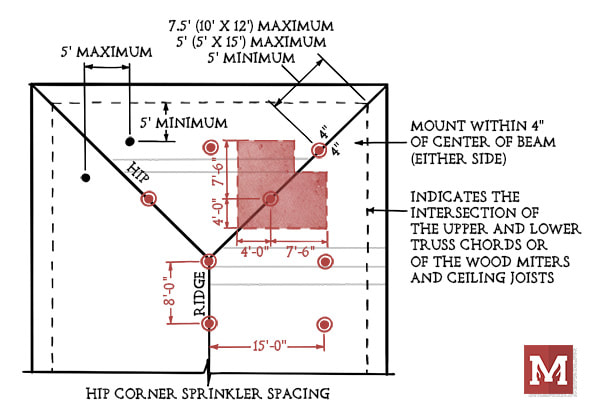
When laying out an attic, if you design with sprinklers directly under the hips, and want to stay below the 8' spacing against the slope, how does the layout work?

One direction of the roof would be 4' x 7'-6" max, but the other direction of the roof would be reversed, creating a non-linear coverage area.

All of it seems strange to begin with and wondering if I'm overthinking this.

We typically don't design with sprinklers directly under the hips, but I'm wondering if we are over designing with too many sprinklers, etc.
Picture
​​​​​​​​​​​​​​​​​​​​​​​​​Sent in anonymously for discussion. Click Title to View | Submit Your Question | Subscribe​
5 Comments
Jesse
10/3/2022 08:18:24 am

Attic layout can be funny. If you are using the Tyco product the data sheet has some excellent examples.

Reply
Eric R
10/3/2022 08:49:12 am

My simple answer is to just use a special application sprinkler! I worked in more attic trusses than I count when I was in the field, and hip roofs were always a challenge. Trying to follow the prescriptive requirements in NFPA 13 can be very difficult when designing in a 3D space like that, and the challenge is compounded when the design hits the field and excess framing elements make it almost impossible to follow the NFPA arrangement rules.

With all the major manufacturers now having listed attic heads on the market using standard spray uprights is just punishing yourself unnecessarily.

Victaulic and Reliable in particular both have excellent arrangement guides for hip roof areas that will let you feel more confident that your layout will work as expected. Also, the fact that none of the specially listed designs utilize heads directly under the hip line (barring TYCO's special HIP head) should probably hint that it's not the best way to protect those areas.

Reply
Alex
10/3/2022 09:00:30 am

Hi,

I would highly doubt that attic design would be anyone's favorite area... I've used the Tyco spec sheets to help in the past.

Link: https://www.tyco-fire.com/products-and-solutions/sprinklers-nozzles-and-accessories/special-application/attic_fis/attic-sprinklers#technicalspec

Thanks,
Alex

Reply
Steven
10/3/2022 09:01:13 am

I agree with Eric, I almost always prefer the special application attic sprinklers from a design standpoint. However, they are substantially more expensive and sometimes they won't save you enough sprinklers to justify the cost. When you do have to use standard spray sprinklers, you are certainly right -- sprinkler head layouts at the hips can end up looking a bit strange. I doubt you are overthinking it -- attic layouts can be quite challenging, especially if you are also installing it as a dry system.

I can share how I like to handle the sprinklers near the hips, but there are of course many ways to do it (and I'm not saying my method is the best, it just works for me). I start by laying heads out along the ridge, which is normally easy enough. Once we get to the hip, I treat it almost as if it is a wall -- I lay out heads down each part of the roof slopes, independent of each other. In other words, I space heads along the east-sloping roof with spacing up to 15'-0 x 8'-0, usually staggering the heads from the row of heads above. As I approach the hip (which I am temporarily treating as a wall), I make sure I have a sprinkler within 4'-0 of it (half of 8'-0). I do the same thing on the north-sloping roof, and the west-sloping roof. Then, I go back and adjust the heads with respect to the hips -- sometimes they will be too close to each other, so I have to shift them one way or another (usually shift in increments of 2'-0 or whatever the truss spacing is). Often it'll take a few iterations of shifting heads, or entire lines, before everything looks okay. As for the corners of the roof, sometimes it might require an extra head to pick up that coverage.

Anyways this is certainly not the only method, nor is it necessarily the best. I'd like to hear if other folks have suggestions or comments.

Reply
Sean K link
10/4/2022 09:02:59 am

Check out Victaulic’s line of attic sprinklers, which even come in a ‘Low Flow’ scheme which reduces water by roughly 70% resulting in system demand ranging from 130-180 gpm.
Victaulic even has a team of experts which are available to support with layout needs and work alongside your design team until it’s done per the submittal specs considering these are ‘specific application’ sprinkler heads.

https://www.victaulic.com/assets/uploads/literature/46.03.pdf

https://www.victaulic.com/assets/uploads/literature/46.02.pdf

https://www.victaulic.com/assets/uploads/literature/46.02.pdf

Reply


Leave a Reply.

    SUBMIT A QUESTION
    Picture
    Why Sponsor?

    ALL-ACCESS

    Picture
    GET ALL OUR TOOLS

    SUBSCRIBE

    Subscribe and learn something new each day:
    I'm Interested In:

    COMMUNITY

    Top Feb '26 Contributors
    Picture
    Picture
    Picture
    Picture
    Picture
    Picture
    Picture
    Picture
    Picture
    Picture
    SEE LEADERBOARD

    YOUR POST

    SUBMIT A QUESTION

    PE EXAM

    Get 100 Days of Free Sample Questions right to you!
    SIGN ME UP!

    FILTERS

    All
    A1171
    ABA
    ADA
    ASCE 7
    ASME A17.1
    ASTM E1354
    Blog Thread
    Daily Discussion
    Design-documents
    EN 12259-1
    EN 12845
    Explosion Protection
    Explosion-protection-prevention
    Fire Detection And Alarm Systems
    Fire Dynamics
    Flammable And Combustible Liquids
    Flammable-combustible-liquids
    FM Global
    Human-behavior
    IBC
    ICC 500
    IEBC
    IFC
    IMC
    IPC
    IRC
    ISO
    Means Of Egress
    NBC
    NFPA 1
    NFPA 10
    NFPA 101
    NFPA 11
    NFPA 110
    NFPA 1142
    NFPA 1221
    NFPA 13
    NFPA 13D
    NFPA 13R
    NFPA 14
    NFPA 15
    NFPA 16
    NFPA 17A
    NFPA 20
    NFPA 2001
    NFPA 214
    NFPA 22
    NFPA 220
    NFPA 24
    NFPA 241
    NFPA 25
    NFPA 291
    NFPA 30
    NFPA 307
    NFPA 30B
    NFPA 31
    NFPA 33
    NFPA 37
    NFPA 400
    Nfpa-409
    Nfpa-415
    Nfpa-45
    Nfpa-495
    NFPA 497
    NFPA 5000
    NFPA 502
    NFPA 54
    NFPA 55
    NFPA 654
    NFPA 68
    NFPA 70
    NFPA 701
    NFPA 72
    NFPA 75
    NFPA 770
    NFPA 82
    NFPA 850
    NFPA 855
    NFPA 90A
    NFPA 92
    NFPA 96
    NICET
    OBC
    OSHA
    Passive Building Systems
    PE Prep Guide
    PE Prep Series
    PE Sample Problems
    Poll
    Smoke Management
    Special Hazard Systems
    UFC 3-600-01
    UFC 4-021-01
    UFC 4-211-01
    UPC
    Updates
    Water Based Fire Suppression
    Weekly Exams


    ARCHIVES

    March 2026
    February 2026
    January 2026
    December 2025
    November 2025
    October 2025
    September 2025
    August 2025
    July 2025
    June 2025
    May 2025
    April 2025
    March 2025
    February 2025
    January 2025
    December 2024
    November 2024
    October 2024
    September 2024
    August 2024
    July 2024
    June 2024
    May 2024
    April 2024
    March 2024
    February 2024
    January 2024
    December 2023
    November 2023
    October 2023
    September 2023
    August 2023
    July 2023
    June 2023
    May 2023
    April 2023
    March 2023
    February 2023
    January 2023
    December 2022
    November 2022
    October 2022
    September 2022
    August 2022
    July 2022
    June 2022
    May 2022
    April 2022
    March 2022
    February 2022
    January 2022
    December 2021
    November 2021
    October 2021
    September 2021
    August 2021
    July 2021
    June 2021
    May 2021
    April 2021
    March 2021
    February 2021
    January 2021
    December 2020
    November 2020
    October 2020
    September 2020
    August 2020
    July 2020
    June 2020
    May 2020
    April 2020
    March 2020
    February 2020
    January 2020
    December 2019
    November 2019
    October 2019
    September 2019
    August 2019
    July 2019
    June 2019
    May 2019
    April 2019
    March 2019
    February 2019
    January 2019
    December 2018
    November 2018
    October 2018
    September 2018
    August 2018
    July 2018
    June 2018
    May 2018
    November 2017
    October 2017
    September 2017
    August 2017
    July 2017
    June 2017
    November 2016
    October 2016
    July 2016
    June 2016


    PE PREP SERIES

    SEE LEADERBOARD

    SEARCH THE FORUM

    RSS Feed

Picture
​Home
Our Cause
The Blog
The Forum
PE Exam Prep
The Toolkit

MeyerFire University
​Pricing
Login
​Support
Contact Us
Picture

MeyerFire.com is a startup community built to help fire protection professionals shine.
Our goal is to improve fire protection practices worldwide. We promote the industry by creating helpful tools and resources, and by bringing together industry professionals to share their expertise.

​MeyerFire, LLC is a NICET Recognized Training Provider and International Code Council Preferred Education Provider.

All text, images, and media ​Copyright © 2016-2025 MeyerFire, LLC

We respect your privacy and personal data. See our Privacy Policy and Terms of Service. 
The views, opinions, and information found on this site represent solely the author and do not represent the opinions of any other party, nor does the presented material assume responsibility for its use. Fire protection and life safety systems constitute a critical component for public health and safety and you should consult with a licensed professional for proper design and code adherence.

Discussions are solely for the purpose of peer review and the exchange of ideas. All comments are reviewed. Comments which do not contribute, are not relevant, are spam, or are disrespectful in nature may be removed. Information presented and opinions expressed should not be relied upon as a replacement for consulting services. Some (not all) outbound links on this website, such as Amazon links, are affiliate-based where we receive a small commission for orders placed elsewhere.

  • Blog
  • Forum
  • TOOLKIT
    • ALL TOOLS
    • BUY THE TOOLKIT
  • UNIVERSITY
    • ALL COURSES
    • JOIN THE UNIVERSITY
  • PE Exam
    • PE Forum & Errata
    • PE Store
    • PE Tools
    • PE PREP SERIES
    • PE Old Questions
  • LOGIN
    • TOOLKIT-ONLY LOGIN
    • UNIVERSITY LOGIN
  • STORE
  • OUR CAUSE
    • ABOUT MEYERFIRE
    • JOB OPENINGS
    • BECOME AN INSTRUCTOR
    • HELP/SUPPORT