
MeyerFire
  • Blog
  • Forum
  • TOOLKIT
    • ALL TOOLS
    • BUY THE TOOLKIT
  • UNIVERSITY
    • ALL COURSES
    • JOIN THE UNIVERSITY
  • PE Exam
    • PE Forum & Errata
    • PE Store
    • PE Tools
    • PE PREP SERIES
    • PE Old Questions
  • LOGIN
    • TOOLKIT-ONLY LOGIN
    • UNIVERSITY LOGIN
  • STORE
  • OUR CAUSE
    • ABOUT MEYERFIRE
    • JOB OPENINGS
    • BECOME AN INSTRUCTOR
    • HELP/SUPPORT
Picture

Hanger Supported by CPVC Pipe Acceptable?

12/6/2022

12 Comments

 
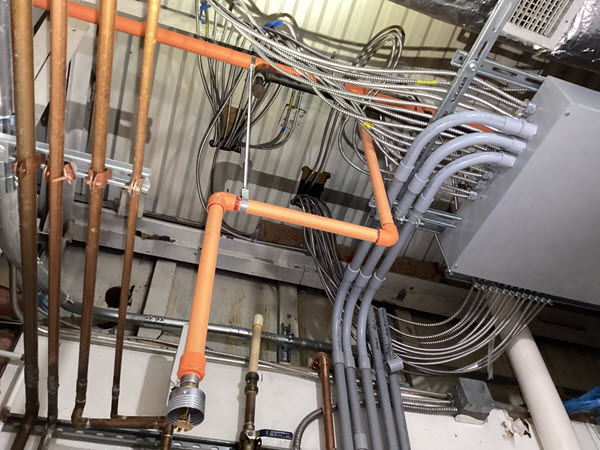
I am an AHJ and trying to determine if this CPVC/BlazeMaster pipe has the correct hanger arrangement.

I was unable to find anything in the BlazeMaster installation manual. You can see from the photo that the sprinkler branch line hanger is attached to the building steel structural beam.

However the sprinkler drop is supported by a hanger, attached to the branch line, and not to a building structural element.

​Is this a correct method of supporting a sprinkler drop?
Picture

​​​​​​​​​​​​​​​​​​​​​​​​​Sent in anonymously for discussion. Click Title to View | Submit Your Question | Subscribe
12 Comments
Dan Wilder
12/6/2022 06:43:04 am

I've done it with steel using the trapeze tables within NFPA 13 however I cannot find anything as to section modulus or spans for CPVC. This would be a call to the MFG or a request to the installing contractor to provide the engineering backup for this installation.

Due to the flexible nature of CPVC and the much lower spans available for just hanging, this picture/installation would push me to an alternate solution.

Personally, I would have placed an additional hanger within 6" of the upper attachment point of this trapeze hanger, while keeping the standard hanger spacing on the upper line (unless I went down the road of MFG's data for modulus values and such) or just swung the lower arm-over out a couple inches for a clear shot to the deck with a hanger.

Reply
Ryan
9/6/2024 07:30:59 am

You can not hang sprinkler pipe from itself. Only a trapeze and that is not a trapeze.

Reply
Alex
12/6/2022 07:16:37 am

Hi, as Dan mentioned above, its common with steel but I have never seen it with CPVC. I would simply ask the installing contractor to have the manufacture provide a letter stating the installation is acceptable.

Reply
Anthony
12/6/2022 08:07:40 am

Not ok without 'showing your work' if the math works out it would be acceptable. I however doubt that would be the case. That doesn't pass the eyeball test, looks like it would break with that 250lb (me) hanging from it that is required for NFPA-13 hangers.

Reply
martin m. link
12/6/2022 08:11:58 am

When in doubt "default" to AHJ
Merry Christmas to all, Happy Holidays and New Year!

Reply
James Phifer
12/6/2022 08:19:17 am

The appendix 2016 ed. NFPA 13: A.9.1.1.8.1 - provides the option to support sprinkler piping from other sprinkler piping where the requirements of 9.1.1.2 are met. meaning it must support the weight of the water filled pipe plus 250 lbs, Like Anthony mentioned, I doubt that would support 250 lbs.

Reply
Craig Vesely link
12/6/2022 08:21:17 am

Referencing the 2022 edition of NFPA 13, Section A.17.1.3.1 states, "NFPA 13 provides the option to support sprinkler piping from other sprinkler piping where the requirements of 17.1.2 are met." I would use this verbiage to explain the intent of the Technical Committee to the installing contractor.

Reply
Glenn Berger
12/6/2022 08:33:51 am

It looks wrong and probably not originally designed this way. I would hoped to have see a pipe hanger for the branch pipe above.

Reply
Todd E Wyatt
12/6/2022 08:37:59 am

SHORT ANSWER
Request the listing information for this CPVC installation.

EXPLANATION
2022 NFPA 13 states the following :

17.4.3.4 * Unsupported Lengths.
A.17.4.3.4
Sprinkler piping should be adequately secured to restrict the movement of piping upon sprinkler operation. The reaction forces caused by the flow of water through the sprinkler could result in displacement of the sprinkler, thereby adversely affecting sprinkler discharge. Listed CPVC pipe has specific requirements for piping support to include additional pipe bracing of sprinklers. (See Figure A.17.4.3.4.)

ENHANCED CONTENT
As Figure A.17.4.3.4 illustrates, extending the branch line to the next structural member prevents an excessive cantilever of the piping.

I apoligize that I cannot attach "Figure A.17.4.3.4" to this message.

2022 NFPA 13 also states the following regarding "nonmetalic pipe and tubing" :

7.3.2* Nonmetallic Pipe and Tubing.
7.3.2.1.1
Other types of nonmetallic pipe or tube investigated for suitability in automatic sprinkler installations and listed for this service, including but not limited to CPVC, and differing from that provided in Table 7.3.1.1 shall be permitted where installed in accordance with their listing limitations.
7.3.2.1.2
Manufacturer’s installation instructions shall include its listing limitations.

A.7.3.2
CPVC is a plastic material, and consideration is necessary when other materials or chemicals come in contact with CPVC that can cause degradation of performance of the pipe due to interaction of materials. Other construction materials include but are not limited to materials used in fabrication of the sprinkler system, additives to water supplies, cable, and wiring, and certain insecticides and fungicides. Compliance with 7.3.2 combined with following the manufacturer’s guidance on installation and compatible materials will help prevent premature performance degradation of non-metallic piping. Mechanical stress caused by hanging methods or bending on non-metallic piping beyond the manufacturers recommended limitations can cause stress failure over time and should be avoided.

Other types of pipe and tube that have been investigated and listed for sprinkler applications include thermoplastic pipe and fittings. While these products can offer advantages, such as ease of handling and installation, cost-effectiveness, reduction of friction losses, and improved corrosion resistance, it is important to recognize that they also have limitations that are to be considered by those contemplating their use or acceptance.

With respect to thermoplastic pipe and fittings, exposure of such piping to elevated temperatures in excess of that for which it has been listed can result in distortion or failure. Accordingly, care must be exercised when locating such systems to ensure that the ambient temperature, including seasonal variations, does not exceed the rated value.

The upper service temperature limit of currently listed CPVC sprinkler pipe is 150°F (65.5°C) at 175 psi (12.1 bar).

Not all pipe or tube made to ASTM F442, Standard Specification for Chlorinated Poly (Vinyl Chloride) (CPVC) Plastic Pipe (SDR-PR), is listed for fire sprinkler service. Listed pipe is identified by the logo of the listing agency.

Not all fittings made to ASTM F437, Standard Specification for Threaded Chlorinated Poly (Vinyl Chloride) (CPVC) Plastic Pipe Fittings, Schedule 80, ASTM F438, Standard Specification for Socket-Type Chlorinated Poly (Vinyl Chloride) (CPVC) Plastic Pipe Fittings, Schedule 40, and ASTM F439, Standard Specification for Socket-Type Chlorinated Poly (Vinyl Chloride) (CPVC) Plastic Pipe Fittings, Schedule 80, as described in 7.4.4, are listed for fire sprinkler service. Listed fittings are identified by the logo of the listing agency.

Consideration must also be given to the possibility of exposure of the piping to elevated temperatures during a fire. The survival of thermoplastic piping under fire conditions is primarily due to the cooling effect of the discharge from the sprinklers it serves. As this discharge might not occur simultaneously with the rise in ambient temperature and, under some circumstances, can be delayed for periods beyond the tolerance of the piping, protection in the form of a fire-resistant membrane is generally required. (Some listings do provide for the use of exposed piping in conjunction with residential or quick-response sprinklers, but only under specific, limited installation criteria.)

Where protection is required, it is described in the listing information for each individual product, and the requirements given must be followed. It is equally important that such protection must be maintained. Removal of, for example, one or more panels in a lay-in ceiling can expose piping in the concealed space to the possibility of failure in the event of a fire. Similarly, the relocation of openings through protective ceilings that expose the pipe to heat, inconsistent with

Reply
Jesse
12/6/2022 08:39:13 am

You can support sprinkler pipe from other sprinkler pipe presuming it supports the weight +250 lbs. Not sure that'll support it. I'd consult the manufacturer.

Reply
Randy Kimbro
12/6/2022 08:48:00 am

As usual, you guys are all awesome with the responses. I did note the 250# requirement in NFPA plus the weight of the water in the piping. And I contacted the manufacturer (BlazeMaster) as you recommended who said "absolutely not". They said their pipe must be hung from building steel/structure and never from other CPVC.

In addition, while researching this issue, we stumbled on a much bigger one. This BlazeMaster pipe was installed on a sloped, unprotected ceiling of a restaurant. The manufacturer requires that the CPVC pipe be protected or installed against a flat, smooth ceiling. The sprinkler contractor is now in the process of removing the CPVC and replacing it with steel on the exposed vaulted ceiling.

Thank you for the guidance and Merry Christmas!

Reply
martin m link
12/7/2022 10:56:56 am

Yes Sir the knowledge,wisdom and experience is amazing! I have learned so much from so many and for Meyer fire making this venue possible
Thank you
Martin M

Reply


Leave a Reply.

    SUBMIT A QUESTION
    Picture
    Why Sponsor?

    ALL-ACCESS

    Picture
    GET ALL OUR TOOLS

    SUBSCRIBE

    Subscribe and learn something new each day:
    I'm Interested In:

    COMMUNITY

    Top Dec '25 Contributors
    Picture
    Picture
    Picture
    Picture
    Picture
    Picture
    Picture
    Picture
    Picture
    Picture
    SEE LEADERBOARD

    YOUR POST

    SUBMIT A QUESTION

    PE EXAM

    Get 100 Days of Free Sample Questions right to you!
    SIGN ME UP!

    FILTERS

    All
    A1171
    ABA
    ADA
    ASCE 7
    ASME A17.1
    ASTM E1354
    Blog Thread
    Daily Discussion
    Design-documents
    EN 12259-1
    EN 12845
    Explosion Protection
    Explosion-protection-prevention
    Fire Detection And Alarm Systems
    Fire Dynamics
    Flammable And Combustible Liquids
    Flammable-combustible-liquids
    FM Global
    Human-behavior
    IBC
    ICC 500
    IEBC
    IFC
    IMC
    IPC
    IRC
    ISO
    Means Of Egress
    NBC
    NFPA 1
    NFPA 10
    NFPA 101
    NFPA 11
    NFPA 110
    NFPA 1142
    NFPA 1221
    NFPA 13
    NFPA 13D
    NFPA 13R
    NFPA 14
    NFPA 15
    NFPA 16
    NFPA 17A
    NFPA 20
    NFPA 2001
    NFPA 214
    NFPA 22
    NFPA 220
    NFPA 24
    NFPA 241
    NFPA 25
    NFPA 291
    NFPA 30
    NFPA 307
    NFPA 30B
    NFPA 31
    NFPA 33
    NFPA 37
    NFPA 400
    Nfpa-409
    Nfpa-415
    Nfpa-45
    Nfpa-495
    NFPA 497
    NFPA 5000
    NFPA 502
    NFPA 54
    NFPA 55
    NFPA 654
    NFPA 68
    NFPA 70
    NFPA 701
    NFPA 72
    NFPA 75
    NFPA 770
    NFPA 82
    NFPA 850
    NFPA 855
    NFPA 90A
    NFPA 92
    NFPA 96
    NICET
    OBC
    OSHA
    Passive Building Systems
    PE Prep Guide
    PE Prep Series
    PE Sample Problems
    Poll
    Smoke Management
    Special Hazard Systems
    UFC 3-600-01
    UFC 4-021-01
    UFC 4-211-01
    UPC
    Updates
    Water Based Fire Suppression
    Weekly Exams


    ARCHIVES

    January 2026
    December 2025
    November 2025
    October 2025
    September 2025
    August 2025
    July 2025
    June 2025
    May 2025
    April 2025
    March 2025
    February 2025
    January 2025
    December 2024
    November 2024
    October 2024
    September 2024
    August 2024
    July 2024
    June 2024
    May 2024
    April 2024
    March 2024
    February 2024
    January 2024
    December 2023
    November 2023
    October 2023
    September 2023
    August 2023
    July 2023
    June 2023
    May 2023
    April 2023
    March 2023
    February 2023
    January 2023
    December 2022
    November 2022
    October 2022
    September 2022
    August 2022
    July 2022
    June 2022
    May 2022
    April 2022
    March 2022
    February 2022
    January 2022
    December 2021
    November 2021
    October 2021
    September 2021
    August 2021
    July 2021
    June 2021
    May 2021
    April 2021
    March 2021
    February 2021
    January 2021
    December 2020
    November 2020
    October 2020
    September 2020
    August 2020
    July 2020
    June 2020
    May 2020
    April 2020
    March 2020
    February 2020
    January 2020
    December 2019
    November 2019
    October 2019
    September 2019
    August 2019
    July 2019
    June 2019
    May 2019
    April 2019
    March 2019
    February 2019
    January 2019
    December 2018
    November 2018
    October 2018
    September 2018
    August 2018
    July 2018
    June 2018
    May 2018
    November 2017
    October 2017
    September 2017
    August 2017
    July 2017
    June 2017
    November 2016
    October 2016
    July 2016
    June 2016


    PE PREP SERIES

    SEE LEADERBOARD

    SEARCH THE FORUM

    RSS Feed

Picture
​Home
Our Cause
The Blog
The Forum
PE Exam Prep
The Toolkit

MeyerFire University
​Pricing
Login
​Support
Contact Us
Picture

MeyerFire.com is a startup community built to help fire protection professionals shine.
Our goal is to improve fire protection practices worldwide. We promote the industry by creating helpful tools and resources, and by bringing together industry professionals to share their expertise.

​MeyerFire, LLC is a NICET Recognized Training Provider and International Code Council Preferred Education Provider.

All text, images, and media ​Copyright © 2016-2025 MeyerFire, LLC

We respect your privacy and personal data. See our Privacy Policy and Terms of Service. 
The views, opinions, and information found on this site represent solely the author and do not represent the opinions of any other party, nor does the presented material assume responsibility for its use. Fire protection and life safety systems constitute a critical component for public health and safety and you should consult with a licensed professional for proper design and code adherence.

Discussions are solely for the purpose of peer review and the exchange of ideas. All comments are reviewed. Comments which do not contribute, are not relevant, are spam, or are disrespectful in nature may be removed. Information presented and opinions expressed should not be relied upon as a replacement for consulting services. Some (not all) outbound links on this website, such as Amazon links, are affiliate-based where we receive a small commission for orders placed elsewhere.

  • Blog
  • Forum
  • TOOLKIT
    • ALL TOOLS
    • BUY THE TOOLKIT
  • UNIVERSITY
    • ALL COURSES
    • JOIN THE UNIVERSITY
  • PE Exam
    • PE Forum & Errata
    • PE Store
    • PE Tools
    • PE PREP SERIES
    • PE Old Questions
  • LOGIN
    • TOOLKIT-ONLY LOGIN
    • UNIVERSITY LOGIN
  • STORE
  • OUR CAUSE
    • ABOUT MEYERFIRE
    • JOB OPENINGS
    • BECOME AN INSTRUCTOR
    • HELP/SUPPORT