MeyerFire
  • Blog
  • Forum
  • TOOLKIT
    • ALL TOOLS
    • BUY THE TOOLKIT
  • UNIVERSITY
    • ALL COURSES
    • JOIN THE UNIVERSITY
  • PE Exam
    • PE Forum & Errata
    • PE Store
    • PE Tools
    • PE PREP SERIES
    • PE Old Questions
  • LOGIN
    • TOOLKIT-ONLY LOGIN
    • UNIVERSITY LOGIN
  • STORE
  • OUR CAUSE
    • ABOUT MEYERFIRE
    • JOB OPENINGS
    • BECOME AN INSTRUCTOR
    • HELP/SUPPORT
Picture

Does Wood Plywood Qualify as Encapsulation?

11/7/2023

9 Comments

 
We are doing a design for high-piled storage of Class I-IV commodities in a palletized arrangement. Storage is 15'-6" high.

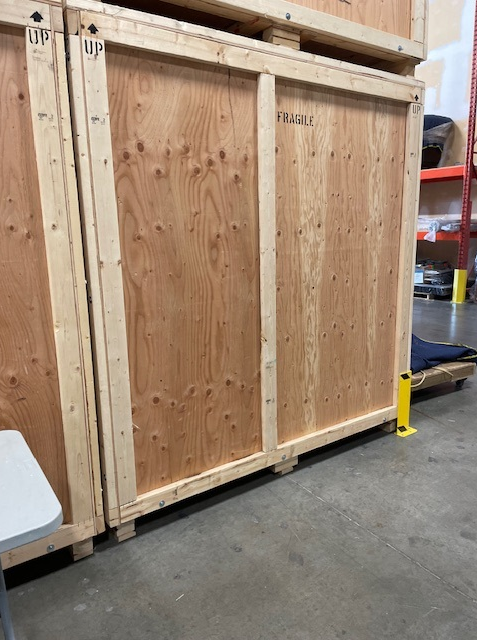
Would this storage (image below) also count/qualify as "encapsulated" under NFPA 13 (2013 Edition)?
Picture
The client is a remediation company that uses heavy plywood crates to temporarily store items for their clients (which are common household items).

Section 3.9.1.12 includes "a combustible package" as a method of encapsulation, but annex A.3.9.1.12 says "The term encapsulated does not apply to plastic-enclosed products or packages inside a large, non-plastic, enclosed container.".

Does a heavy plywood crate count as encapsulation, or not?

This matters because at 15.5 feet in height I would have to use the flow densities from 14.2.5 instead of the reduced ones from 14.2.4 if it does.

Thanks very much for your help.

​​​​​​​​​​​​​​​​​​​​​​​​​Sent in anonymously for discussion. Click Title to View | Submit Your Question | Subscribe
9 Comments
Pete H
11/7/2023 06:56:00 am

It doesn't count as encapsulation. From NFPA 13 (2013 edition)

3.9.1.12 Encapsulation - A method of packaging that either consists of a plastic sheet completely enclosing the sides and top of a pallet load containing a combustible commodity, a combustible package, or a group of combustible packages [you don't have this as the combustible plywood container is outside of the plastic and part of the pallet load] or consists of combustible commodities individually wrapped in plastic sheeting and stored exposed in a pallet load [your stuff isn't stored exposed, it's inside a plywood box.]

A.3.9.1.12 Encapsulation - Totally noncombustible commodities [you don't have this] on wood pallets enclosed only by a plastic sheet as described are not covered under this definition. Banding (i,.e,. stretch-wrapping around the sides only of a pallet load) is not considered to be encapsulation. Where there are holes or voids in the plastic or waterproof cover on the top of the carton that exceed more than half the area of the cover, the term encapsulated does not apply. The term encapsulated does not apply to plastic-enclosed products or packages inside a large, nonplastic, enclosed container [this is what you may have, but the term encapsulated does not apply].

Reply
JI
11/7/2023 08:15:29 am

This is the way I read it as well. The "combustible packaging" refers to what is being encapsulated, and does not describe another type of encapsulation.

Reply
Alex
11/7/2023 08:31:53 am

I agree with Pete here! Not much more to add.

Reply
Jesse
11/7/2023 08:18:17 am

That's not encapsulated. Encapsulation typically uses a polystyrene or similar wrap on 5 sides of the load.

I had a warehouse once that used similar in a high piled (palletized) storage array. I wanna say we treated it as a Class III Commodity.

Reply
Nick
11/7/2023 08:29:39 am

I would be careful of following the commodity classifications found in chapter 5.6 of NFPA 13. See Table A.5.6 for examples of commodities not addressed by NFPA 13. It specifically lists "Storage Container - Large container storage of household goods" as not being addressed which I believe is the exact condition you show here.

If that is the case, providing coverage for a class I-IV commodity would not cover this storage arrangement, regardless of "encapsulation" or not. This will probably require a performance based design or further research into other standards that have done testing for protection of these crates. I have to imagine there is a very specific reason why NFPA 13 directly states that their definition of commodities does not address this scenario.

Reply
Glenn Berger
11/7/2023 08:54:54 am

This is a classic case of utilizing the definitions from the standard being questioned.

NFPA 13 definitions apply to this scenario and your photo does not meet the definition of encapsulated.

Reply
Casey Milhorn
11/7/2023 09:17:27 am

Nick is spot on. This storage arrangement is becoming very popular with the self storage/moving companies. The customer can pack whatever they want in there while it sits in their driveway, close the door on it, have it picked up and stored two or three containers high in a warehouse that many times was never designed for this. I did a little research a few months back and I could not find any testing that has been done on this type of storage (I didn't spend a whole lot of time on it either). It definitely should be performance based design with someone experienced with this type of storage. It could test out very well in fire testing and be protected with OH2, then again it might need 2000gpm+ of ESFR protection, or not even allowed at all in certain arrangements. I would imagine the performance based spec would also dictate spacing of containers, flue spaces, aisles, max# of containers that can be stacked, clearance to roof sprinklers, etc.... just my two cents

Reply
OP
11/7/2023 09:29:15 am

Thanks everyone! I was leaning that way too but I wanted a few extra sets of eyes on it first.

Much appreciated. Gotta love this community. :-)

Reply
Dan Wilder
11/7/2023 11:16:02 am

Encapsulation - I look at it as the ability to not allow prewetting of the pallet load (sides AND top) mostly with the use of plastic wrapping.

Not sure how the initial Class IV designation would work as furniture (with cushions) is a Group A? Maybe getting there via modifiers down the line but shielding should also be a criteria in the evaluation.

This storage arrangement would fall outside NFPA 13's scope based on the picture and description IMO.

The last half of the article has some good insights:
https://www.sfpe.org/publications/fpemagazine/fpearchives/2006q1/2006q12

Reply


Leave a Reply.

    SUBMIT A QUESTION
    Picture
    Why Sponsor?

    ALL-ACCESS

    Picture
    GET ALL OUR TOOLS

    SUBSCRIBE

    Subscribe and learn something new each day:
    I'm Interested In:

    COMMUNITY

    Top Feb '26 Contributors
    Picture
    Picture
    Picture
    Picture
    Picture
    Picture
    Picture
    Picture
    Picture
    Picture
    SEE LEADERBOARD

    YOUR POST

    SUBMIT A QUESTION

    PE EXAM

    Get 100 Days of Free Sample Questions right to you!
    SIGN ME UP!

    FILTERS

    All
    A1171
    ABA
    ADA
    ASCE 7
    ASME A17.1
    ASTM E1354
    Blog Thread
    Daily Discussion
    Design-documents
    EN 12259-1
    EN 12845
    Explosion Protection
    Explosion-protection-prevention
    Fire Detection And Alarm Systems
    Fire Dynamics
    Flammable And Combustible Liquids
    Flammable-combustible-liquids
    FM Global
    Human-behavior
    IBC
    ICC 500
    IEBC
    IFC
    IMC
    IPC
    IRC
    ISO
    Means Of Egress
    NBC
    NFPA 1
    NFPA 10
    NFPA 101
    NFPA 11
    NFPA 110
    NFPA 1142
    NFPA 1221
    NFPA 13
    NFPA 13D
    NFPA 13R
    NFPA 14
    NFPA 15
    NFPA 16
    NFPA 17A
    NFPA 20
    NFPA 2001
    NFPA 214
    NFPA 22
    NFPA 220
    NFPA 24
    NFPA 241
    NFPA 25
    NFPA 291
    NFPA 30
    NFPA 307
    NFPA 30B
    NFPA 31
    NFPA 33
    NFPA 37
    NFPA 400
    Nfpa-409
    Nfpa-415
    Nfpa-45
    Nfpa-495
    NFPA 497
    NFPA 5000
    NFPA 502
    NFPA 54
    NFPA 55
    NFPA 654
    NFPA 68
    NFPA 70
    NFPA 701
    NFPA 72
    NFPA 75
    NFPA 770
    NFPA 82
    NFPA 850
    NFPA 855
    NFPA 90A
    NFPA 92
    NFPA 96
    NICET
    OBC
    OSHA
    Passive Building Systems
    PE Prep Guide
    PE Prep Series
    PE Sample Problems
    Poll
    Smoke Management
    Special Hazard Systems
    UFC 3-600-01
    UFC 4-021-01
    UFC 4-211-01
    UPC
    Updates
    Water Based Fire Suppression
    Weekly Exams


    ARCHIVES

    March 2026
    February 2026
    January 2026
    December 2025
    November 2025
    October 2025
    September 2025
    August 2025
    July 2025
    June 2025
    May 2025
    April 2025
    March 2025
    February 2025
    January 2025
    December 2024
    November 2024
    October 2024
    September 2024
    August 2024
    July 2024
    June 2024
    May 2024
    April 2024
    March 2024
    February 2024
    January 2024
    December 2023
    November 2023
    October 2023
    September 2023
    August 2023
    July 2023
    June 2023
    May 2023
    April 2023
    March 2023
    February 2023
    January 2023
    December 2022
    November 2022
    October 2022
    September 2022
    August 2022
    July 2022
    June 2022
    May 2022
    April 2022
    March 2022
    February 2022
    January 2022
    December 2021
    November 2021
    October 2021
    September 2021
    August 2021
    July 2021
    June 2021
    May 2021
    April 2021
    March 2021
    February 2021
    January 2021
    December 2020
    November 2020
    October 2020
    September 2020
    August 2020
    July 2020
    June 2020
    May 2020
    April 2020
    March 2020
    February 2020
    January 2020
    December 2019
    November 2019
    October 2019
    September 2019
    August 2019
    July 2019
    June 2019
    May 2019
    April 2019
    March 2019
    February 2019
    January 2019
    December 2018
    November 2018
    October 2018
    September 2018
    August 2018
    July 2018
    June 2018
    May 2018
    November 2017
    October 2017
    September 2017
    August 2017
    July 2017
    June 2017
    November 2016
    October 2016
    July 2016
    June 2016


    PE PREP SERIES

    SEE LEADERBOARD

    SEARCH THE FORUM

    RSS Feed

Picture
​Home
Our Cause
The Blog
The Forum
PE Exam Prep
The Toolkit

MeyerFire University
​Pricing
Login
​Support
Contact Us
Picture

MeyerFire.com is a startup community built to help fire protection professionals shine.
Our goal is to improve fire protection practices worldwide. We promote the industry by creating helpful tools and resources, and by bringing together industry professionals to share their expertise.

​MeyerFire, LLC is a NICET Recognized Training Provider and International Code Council Preferred Education Provider.

All text, images, and media ​Copyright © 2016-2025 MeyerFire, LLC

We respect your privacy and personal data. See our Privacy Policy and Terms of Service. 
The views, opinions, and information found on this site represent solely the author and do not represent the opinions of any other party, nor does the presented material assume responsibility for its use. Fire protection and life safety systems constitute a critical component for public health and safety and you should consult with a licensed professional for proper design and code adherence.

Discussions are solely for the purpose of peer review and the exchange of ideas. All comments are reviewed. Comments which do not contribute, are not relevant, are spam, or are disrespectful in nature may be removed. Information presented and opinions expressed should not be relied upon as a replacement for consulting services. Some (not all) outbound links on this website, such as Amazon links, are affiliate-based where we receive a small commission for orders placed elsewhere.

  • Blog
  • Forum
  • TOOLKIT
    • ALL TOOLS
    • BUY THE TOOLKIT
  • UNIVERSITY
    • ALL COURSES
    • JOIN THE UNIVERSITY
  • PE Exam
    • PE Forum & Errata
    • PE Store
    • PE Tools
    • PE PREP SERIES
    • PE Old Questions
  • LOGIN
    • TOOLKIT-ONLY LOGIN
    • UNIVERSITY LOGIN
  • STORE
  • OUR CAUSE
    • ABOUT MEYERFIRE
    • JOB OPENINGS
    • BECOME AN INSTRUCTOR
    • HELP/SUPPORT