
MeyerFire
  • Blog
  • Forum
  • TOOLKIT
    • ALL TOOLS
    • BUY THE TOOLKIT
  • UNIVERSITY
    • ALL COURSES
    • JOIN THE UNIVERSITY
  • PE Exam
    • PE Forum & Errata
    • PE Store
    • PE Tools
    • PE PREP SERIES
    • PE Old Questions
  • STUDENTS
    • LAND JOB/INTERNSHIPS
    • STUDENT CONNECTOR
  • LOGIN
    • TOOLKIT-ONLY LOGIN
    • UNIVERSITY LOGIN
  • STORE
  • OUR CAUSE
    • ABOUT MEYERFIRE
    • JOB OPENINGS
    • BECOME AN INSTRUCTOR
    • HELP/SUPPORT
Picture

Are Sprinklers Req'd Below Wood Slat Ceiling?

9/15/2023

15 Comments

 
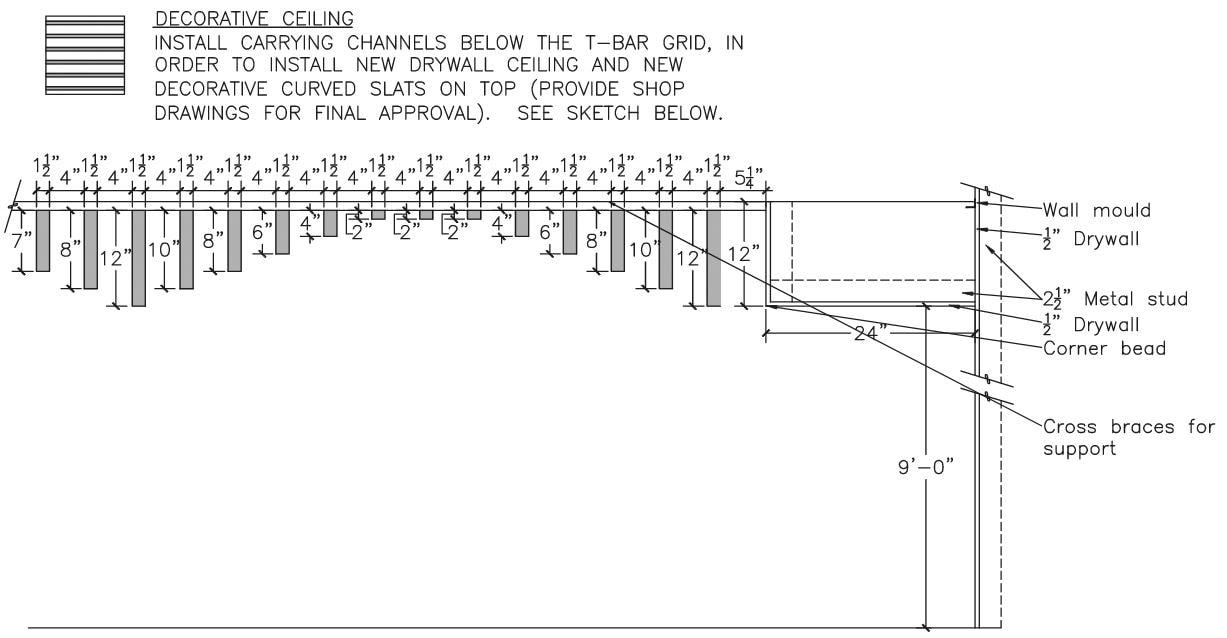
Are pendent sprinklers required below a decorative wood slat feature along the ceiling?

Wood slats vary in height from 4" to 12" but is suspended at ceiling height (9'-0").

The area above the slats is concealed space and requires uprights. The total area percentage of slats is 42% below the concealed space.
Picture
Thanks in advance.

​​​​​​​​​​​​​​​​​​​​​​​​Sent in anonymously for discussion. Click Title to View | Submit Your Question | Subscribe
15 Comments
Pete H
9/15/2023 06:46:17 am

Can you protect this room with sidewalls?

Specifically with deflectors 12" below the ceiling?

Reply
Pete H
9/15/2023 06:48:27 am

Also giving it an extra few seconds, it doesn't look like 9'-0" is your ceiling height the slats are suspended from in that pic, it looks like 9'-0" is the height of the ceiling under the 12" soffit and the slats are suspended from the 10'-0" ceiling above that. Is this the case?

Either way, I'd still try to work with sidewalls 12 inches below the ceiling height.

Reply
Pete H
9/15/2023 06:57:41 am

And finally to actually answer the question, yes you need to protect the floor under the wood slats,. If the above area is a combustible concealed space, you need to have protection at both levels.

You will only need to calculate protection at one level. But it must be present at both.

James Evans
9/15/2023 09:11:59 am

You could not use sidewalls at 12" below the cieling because the soffit and the slats end at 12". This means your sidewall would need to be more than 12" if used on that wall with the soffit. Unless you sprayed from an adjacent wall opposite the slats. In situations like this we usually use a pend sprinkler on a bell reducer with no skirt or escutcheon and make the deflector about an 1" below the slats. the pipe can be painted to match the color.

Reply
DAVE
9/15/2023 10:40:28 am

Unfortunately, sidewalls can only be installed below smooth, horizontal, or sloped flat ceilings (LH) or smooth, flat ceiling where specifically listed.

Reply
Glenn Berger
9/15/2023 08:14:21 am

Your question states that the space above the slats is "concealed." Sprinklers would be required to protect the space below the decorative ceiling feature.

Reply
Anthony
9/15/2023 08:27:48 am

Yes, sprinklers are required in the habitable space if they're required in the combustible concealed space above..

Maybe drop a pendent sprinkler next to the 12'' slat, shave that slat to 11'' so the sprinkler can operate properly. Paint the pipe and get a custom color exposed pendant.

I'm referencing the fact that sprinkler deflectors must be within 12'' of the ceiling.

Note also, I think your spacing will be 168sqft (130?) not 225sqft due to the fact the wood slats create a combustible ceiling.

Best of luck with the challenging design.

Reply
Juan l
9/15/2023 08:28:28 am

Use EC Tyco side wall heads, and you don’t need any uprights.

Reply
Andrew MacLean
3/24/2025 12:42:41 pm

Nothing about this seems like the Smooth Level ceiling their listing calls for.

Reply
Franck
9/15/2023 08:54:56 am

You have some requirements in NFPA 13 for open-grid ceilings. Which is what you have with your configuration.

9.2.16 Open-Grid Ceilings.
Sprinklers shall not be required below open grid ceiling installations complying with 9.3.10.

9.3.10 * Open-Grid Ceilings.
Open-grid ceilings shall only be installed beneath sprinklers where one of the following is met:

(1) Open-grid ceilings in which the openings are 1∕ 4 in. (6 mm) or larger in the least dimension, where the thickness or depth of the material does not exceed the least dimension of the opening, and where such openings constitute 70 percent of the area of the ceiling material. The spacing of the sprinklers over the open-grid ceiling shall then comply with the following:

(a) In light hazard occupancies where sprinkler spacing (either spray or old-style sprinklers) is less than 10 ft × 10 ft (3 m × 3 m), a minimum clearance of at least 18 in. (450 mm) shall be provided between the sprinkler deflectors and the upper surface of the open-grid ceiling. Where spacing is greater than 10 ft × 10 ft (3 m × 3 m) but less than 10 ft × 12 ft (3 m × 3.7 m), a clearance of at least 24 in. (600 mm) shall be provided from spray sprinklers and at least 36 in. (900 mm) from old-style sprinklers. Where spacing is greater than 10 ft × 12 ft (3 m × 3.7 m), a clearance of at least 48 in. (1.2 m) shall be provided.

(b) In ordinary hazard occupancies, open-grid ceilings shall be permitted to be installed beneath spray sprinklers only. Where sprinkler spacing is less than 10 ft × 10 ft (3 m × 3 m), a minimum clearance of at least 24 in. (600 mm) shall be provided between the sprinkler deflectors and the upper surface of the open-grid ceiling. Where spacing is greater than 10 ft × 10 ft (3 m × 3 m), a clearance of at least 36 in. (900 m) shall be provided.

(2) Other types of open-grid ceilings shall be permitted to be installed beneath sprinklers where they are listed for such service and are installed in accordance with instructions contained in each package of ceiling material.

A.9.3.10
The installation of open-grid egg crate, louver, or honeycomb ceilings beneath sprinklers restricts the sideways travel of the sprinkler discharge and can change the character of discharge.


This means that if your installation does not meet the requirements of 9.3.10, you need sprinklers.

Note that if you can omit sprinklers below the structure, then the sprinkler protection at the ceiling level should be designed for the occupancy in the room (not only for a concealed space area).

Reply
Dan Wilder
9/15/2023 09:16:40 am

Are these slats attached directly to the ceiling?

-Yes to protection below the slats via pendents either within or between the slats. You’ll have to check horizontal obstruction clearances for wherever the deflector/bottom of slats distances are.

If these slats sit below the ceiling, depending on that distance, you may need additional sprinklers above the slats (watch suspended obstruction rules) and due to the less than 70% open, protection below the slats

The area above the ceiling needs to follow the requirements for combustible or noncombustible concealed space requirements.

I’m not a fan of sidewalls for ceilings with this much channeling potential and obstruction to spray patterns parallel to the wall (if looking beyond the smooth flat ceiling requirements)

Reply
SCHULMAN
9/15/2023 09:23:24 am

These guys are right, yes, you need sprinklers ... probably sidewalls are best but if it's an architectural issue and someone doesn't want sidewalls .. (I have done lots of crazy ceilings for lots of crazy bosses) ... you can put the sprinklers on pendants between some of the slats (making sure you have the floor coverage required at a minimum) and drop them to just "in-line" with the bottom edge of the wood slats which will help "hide them" - heck, I've even had contractors custom paint the piping and escutcheons etc... and as always - TALK TO YOUR AHJ.

Reply
Dave L.
9/15/2023 10:57:26 am

This one hits home. I've encountered a lot of variations on this as my architect friends keep coming up with new ideas. In some scenarios with multiple trendy baffles suspended from a ceiling above, I try to work with the architect to get them to suspend the slats low enough from the ceiling so they do not affect the spray pattern. I just had some projects that had areas similar to the posed question where they are attached directly to the ceiling. Sidewall sprinklers cannot be used below this type of ceiling (8.4.2 '16 ed; 10.3.2 '19 ed.). I was able to talk the architect into allowing me to extend 1” drops to pendent sprinklers centered between two slats, deflector just below the slats, let the architect choose the sprinkler color, and paint-out the pipe. Sprinkie made a mock-up to show the architect. They chose painting the pipe over that over a long escutcheon (that us old timers have a nickname for). In my case, the deflector of the pendent was able to be at 12” below the ceiling, although I suppose this could be treated as obstructed construction and go up to 22”. The space above the ceiling is its own situation.

Reply
AM
9/20/2023 03:23:39 pm

If the slat has no backer then we would follow open grid ceilings and protect with uprights, spacing dependent on deflector distance above top of baffle. If the slat has a finished backer and all ceilings return to the deck we would place the pendent at 12" below the finished backer with no uprights above 225sf spacing. If the slat has a backer but all ceilings do not return to deck we would protect above and below 225sf spacing.

Reply
Justin Smith
5/30/2025 08:05:11 am

I've recently run into a situation like this as well, Just wondering if you have to provide sprinkler coverage above and below would you need a water shield to protect the sprinkler head below? It is my understanding that you would.

Reply


Leave a Reply.

    SUBMIT A QUESTION
    Picture
    Why Sponsor?

    ALL-ACCESS

    Picture
    GET ALL OUR TOOLS

    SUBSCRIBE

    Subscribe and learn something new each day:
    I'm Interested In:

    COMMUNITY

    Top April '26 Contributors
    Picture
    Picture
    Picture
    Picture
    Picture
    Picture
    Picture
    Picture
    Picture
    Picture
    SEE LEADERBOARD

    YOUR POST

    SUBMIT A QUESTION

    PE EXAM

    Get 100 Days of Free Sample Questions right to you!
    SIGN ME UP!

    FILTERS

    All
    A1171
    ABA
    ADA
    ASCE 7
    ASME A17.1
    ASTM E1354
    Blog Thread
    Daily Discussion
    Design-documents
    EN 12259-1
    EN 12845
    Explosion Protection
    Explosion-protection-prevention
    Fire Detection And Alarm Systems
    Fire Dynamics
    Flammable And Combustible Liquids
    Flammable-combustible-liquids
    FM Global
    Human-behavior
    IBC
    ICC 500
    IEBC
    IFC
    IMC
    IPC
    IRC
    ISO
    Means Of Egress
    NBC
    NFPA 1
    NFPA 10
    NFPA 101
    NFPA 11
    NFPA 110
    NFPA 1142
    NFPA 1221
    NFPA 13
    NFPA 13D
    NFPA 13R
    NFPA 14
    NFPA 15
    NFPA 16
    NFPA 17A
    NFPA 20
    NFPA 2001
    NFPA 214
    NFPA 22
    NFPA 220
    NFPA 24
    NFPA 241
    NFPA 25
    NFPA 291
    NFPA 30
    NFPA 307
    NFPA 30B
    NFPA 31
    NFPA 33
    NFPA 37
    NFPA 400
    Nfpa-409
    Nfpa-415
    Nfpa-45
    Nfpa-495
    NFPA 497
    NFPA 5000
    NFPA 502
    NFPA 54
    NFPA 55
    NFPA 654
    NFPA 68
    NFPA 70
    NFPA 701
    NFPA 72
    NFPA 75
    NFPA 770
    NFPA 82
    NFPA 850
    NFPA 855
    NFPA 90A
    NFPA 92
    NFPA 96
    NICET
    OBC
    OSHA
    Passive Building Systems
    PE Prep Guide
    PE Prep Series
    PE Sample Problems
    Poll
    Smoke Management
    Special Hazard Systems
    UFC 3-600-01
    UFC 3-601-02
    UFC 4-021-01
    UFC 4-211-01
    UPC
    Updates
    Water Based Fire Suppression
    Weekly Exams


    ARCHIVES

    May 2026
    April 2026
    March 2026
    February 2026
    January 2026
    December 2025
    November 2025
    October 2025
    September 2025
    August 2025
    July 2025
    June 2025
    May 2025
    April 2025
    March 2025
    February 2025
    January 2025
    December 2024
    November 2024
    October 2024
    September 2024
    August 2024
    July 2024
    June 2024
    May 2024
    April 2024
    March 2024
    February 2024
    January 2024
    December 2023
    November 2023
    October 2023
    September 2023
    August 2023
    July 2023
    June 2023
    May 2023
    April 2023
    March 2023
    February 2023
    January 2023
    December 2022
    November 2022
    October 2022
    September 2022
    August 2022
    July 2022
    June 2022
    May 2022
    April 2022
    March 2022
    February 2022
    January 2022
    December 2021
    November 2021
    October 2021
    September 2021
    August 2021
    July 2021
    June 2021
    May 2021
    April 2021
    March 2021
    February 2021
    January 2021
    December 2020
    November 2020
    October 2020
    September 2020
    August 2020
    July 2020
    June 2020
    May 2020
    April 2020
    March 2020
    February 2020
    January 2020
    December 2019
    November 2019
    October 2019
    September 2019
    August 2019
    July 2019
    June 2019
    May 2019
    April 2019
    March 2019
    February 2019
    January 2019
    December 2018
    November 2018
    October 2018
    September 2018
    August 2018
    July 2018
    June 2018
    May 2018
    November 2017
    October 2017
    September 2017
    August 2017
    July 2017
    June 2017
    November 2016
    October 2016
    July 2016
    June 2016


    PE PREP SERIES

    SEE LEADERBOARD

    SEARCH THE FORUM

    RSS Feed

Picture
​Home
Our Cause
The Blog
The Forum
PE Exam Prep
The Toolkit

MeyerFire University
​Pricing
Login
​Support
Contact Us
Picture

MeyerFire.com is a startup community built to help fire protection professionals shine.
Our goal is to improve fire protection practices worldwide. We promote the industry by creating helpful tools and resources, and by bringing together industry professionals to share their expertise.

​MeyerFire, LLC is a NICET Recognized Training Provider and International Code Council Preferred Education Provider.

All text, images, and media ​Copyright © 2016-2025 MeyerFire, LLC

We respect your privacy and personal data. See our Privacy Policy and Terms of Service. 
The views, opinions, and information found on this site represent solely the author and do not represent the opinions of any other party, nor does the presented material assume responsibility for its use. Fire protection and life safety systems constitute a critical component for public health and safety and you should consult with a licensed professional for proper design and code adherence.

Discussions are solely for the purpose of peer review and the exchange of ideas. All comments are reviewed. Comments which do not contribute, are not relevant, are spam, or are disrespectful in nature may be removed. Information presented and opinions expressed should not be relied upon as a replacement for consulting services. Some (not all) outbound links on this website, such as Amazon links, are affiliate-based where we receive a small commission for orders placed elsewhere.

  • Blog
  • Forum
  • TOOLKIT
    • ALL TOOLS
    • BUY THE TOOLKIT
  • UNIVERSITY
    • ALL COURSES
    • JOIN THE UNIVERSITY
  • PE Exam
    • PE Forum & Errata
    • PE Store
    • PE Tools
    • PE PREP SERIES
    • PE Old Questions
  • STUDENTS
    • LAND JOB/INTERNSHIPS
    • STUDENT CONNECTOR
  • LOGIN
    • TOOLKIT-ONLY LOGIN
    • UNIVERSITY LOGIN
  • STORE
  • OUR CAUSE
    • ABOUT MEYERFIRE
    • JOB OPENINGS
    • BECOME AN INSTRUCTOR
    • HELP/SUPPORT