
|
While you're here, we've had great discussions on tackling challenges with bid specifications. I'm very encouraged by the response and I'd like to move things forward with drafting an open, easy-to-digest fire sprinkler specification. My next question for you is - in an ideal, simple, concise fire sprinkler specification - what do you want to see addressed? If you're bidding on a job - what is it that you want to see adequately addressed in the specification? Allowable types of pipe? Types of sprinklers? Use of flexible drops, or other fittings? System types? What is it that you look for that is can't miss in a quality fire sprinkler specification? 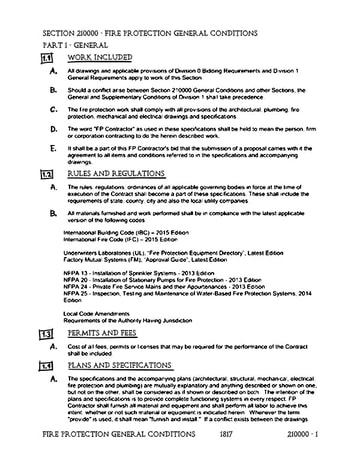 Let me know below and we'll do our best to work it in to a new open fire sprinkler specification.
We've had some breakthroughs with our interactive learning over at MeyerFire University that I wanted to share. If your team could stand to improve their skillset and resources, or you simply haven't looked at our MeyerFire University in awhile, I'd very much encourage you to do so. We are working hard to tangibly shake up the way our industry learns, all for the better. Click the image below to see a sneak preview of what's going live on the University in two weeks (April 29). Thanks for being part of our journey, and I hope you have a great rest of your week! HOW DO WE FIX BAD SPECIFICATIONS?
Last week I touched on a concept of using large language models to instantly review a series of specifications. Thanks for the comments! I’ll write up the step-by-step and incorporate that in a how-to video for posting here and on YouTube. A special shout out to Kimberly Olivas, Brian Gerdwagen and Casey Milhorn on their comments in that thread – very helpful and insightful. The discussion brings me back to two questions I may have inadvertently skipped right over –
A PROBLEM WE CARE TO FIX? If part of a bidding contractor’s value proposition is using their expertise to sort through bad specifications and give an advantage; either in exclusions or clarifications, or change orders later in the process due to inaccuracies, scope not meeting code, or scope gaps. In other words, based on a bidding contractor’s position – there might not be any incentive for them to play their cards for competitors to see through the Pre-Bid RFI process other than a smoother project experience for the owner. A bidding contractor is not a representative of the owner; the consultant is. Ultimately the consultant is responsible for protecting and supporting the owner – which is why they were hired in the first place. Perhaps many contractors don’t look at it that bluntly – but I can understand the sentiment not to tip a hand at project issues when it could mean losing a bid. WHAT’S THE ANSWER? If Pre-Bid RFIs are not the cure-all in today’s pace of estimating – and contractors are not incentivized to be correcting consultant issues – then do we care to actually fix it? For estimators – are bad specifications purely an annoyance for you – or do they cause issues on your projects? Would you prefer that specifications actually be well written? I’m not being facetious – I’d love to know your take on this. ALTERNATIVE APPROACHES If better specifications (and plans) are something we deem better for the industry – and we collectively want better plans and specifications – what is the approach to get there? More specifically, how do we encourage those who don’t really care about fire protection to put a little more effort into their plans and specifications? This was last week’s idea:
Here are some alternative from-the-hip ideas that I’d love to kick around with you and see if you find any of these might be viable: IDEA #1: PUBLISH AN OPEN MICROSOFT WORD FILE BASIC FIRE PROTECTION SPECIFICATION
IDEA #2: CREATE AN AI TOOL FOR CONSULTANTS TO QC THEIR OWN SPECIFICATIONS
IDEA #3: PROMOTE OR CREATE A LOW-COST SPECIFICATION GENERATOR
IDEA #4: HAVE A FORMAL THIRD-PARTY REVIEW PROCESS (A GROUP) FOR SPECIFICATIONS
IDEA #5: PUBLIC HUMILIATION
IDEA #6: YOUR IDEAS
Do you (1) think this is a problem that should be fixed, and (2) what concepts do you think could make a difference? Comment below – would love to foster a deeper discussion on how we might solve this problem before skipping ahead and creating something that might not be impactful. One of the things that frustrates me to no end about our industry are bad specifications. If you want to skip the story and dive right to the end – my ask today is that you comment below on what you would want an automated tool to check for when it reviews a set of specifications? In other words, what issues have you found in specifications in the past that you would want an ideal tool to check for? I’M GUILTY, TOO Before I dive deeper and sound preachy, I have two disclaimers:
WHAT MAKES A BAD SPECIFICATION? What makes a bad fire protection specification? The most dangerous is probably direction which would not meet code minimum. Ambiguity or conflicting information makes bidding difficult. Mandating things which don’t exist for the rest of the industry (such as velocity limitations in hydraulic calculations) can be unnerving and increase cost unnecessarily. Some of the most obvious parts of a bad specification are mandates for products or manufacturers that no longer exist. The goal of a good specification is the same as the plans – clear, unambiguous communication of what is included and not included in a scope of work. 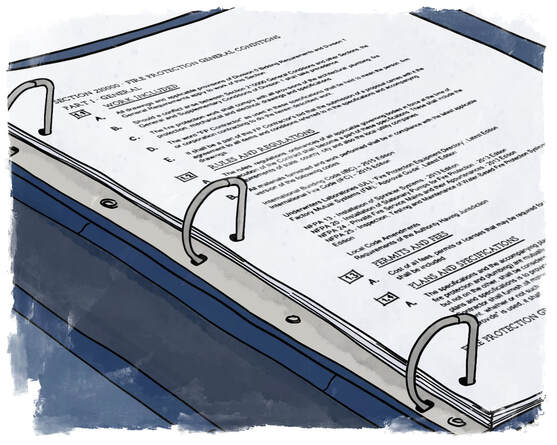 LITTLE RECOURSE
After a project is awarded, a contractor naturally has very little leverage to change the scope of work. Perhaps there are cost-savings options that may be asked of a contractor. Perhaps there’s a change in the project that opens up opportunities to revisit early design decisions. But essentially, after contract award, there’s not a whole lot of leverage against complying with a bad set of specifications. How do we address bad sets of bid documents in our industry? If it’s life threatening and/or egregious, perhaps we could turn people into the governing boards. But how often is that done? How useful is it to permanently burn a bridge for reporting someone that may not even have any consequence? The answer from those I speak with is almost never. Consultants who don’t care about fire protection continue to issue plans and specifications, mostly the same as they always have, with little concern or incentive to change. OUR INITIATIVE Part of creating the community here is recognizing that uplifting everyone makes our industry better. More knowledgeable contractors mean better detailed design and installations. More knowledgeable plan review and inspectors means better policing and better final results across the board. More knowledgeable consultants means that projects flow smoother, owners get what they need, and projects are more timely and on-budget. Part of our responsibility here is to uplift the industry by sharing best practices and making helpful information & tools available that help us all do work better. We have the educational piece (MeyerFire University), we have shorthand tools and cheatsheets. I write posts here. I have ideas in the works on helping improve access to basic, quality sets of specifications. But what about now - as in today? What is the best possible way to actually address a bad set of specifications that will get in the way of a smooth project? PRE-BID RFIs In my opinion, the most underutilized and best way to help foster a smooth project is challenging the scope before bid with a pre-bid RFI. Pre-Bid RFIs (Request for Information) is a documented way to ask questions about the scope of a project before it is bid. These can give an opportunity for a consultant to check their work, check their assumptions, give an opportunity to make a change if necessary, or give a chance to clarify an aspect of the scope. Consultants can choose to play ball – help clarify the job on what should and shouldn’t be included. They can make changes if necessary, and allow bidders to bid apples-to-apples. Contractors can also choose not to play – perhaps double down on the (incorrect) mantra of “this is the contractor’s responsibility to determine”, or something similar. In either case, whether answered or not, Pre-Bid RFIs give the bidders either the information they seek or have greater permission (leverage?) to do as they see fit regarding the scope of the project. SO MORE WORK FOR ME, JOE? Crafting a good pre-bid RFI historically isn’t the easiest thing, though. First – the writer has to digest enough of the project to write something coherent and competent – meaning they need to spend time looking through everything. Second – pre-bid RFIs can sometimes have the presumption that a contractor is causing issues before they’re even on the job. This all comes down to the tone, silly as it might sound. If the pre-bid RFI is accusatory, that’s one thing. But if it’s written to help streamline a smooth project for everyone – then that’s a win for everyone. Third – and perhaps the reason that pre-bid RFIs don’t happen as often as they should, is simply time. Bid days are time crunches. There’s a lot on the line. Going out of your way to clarify a project when you’re already on a time crunch can be tough. This is the piece I’d like to help solve, and I think we can with some of your input. THE CONCEPT What if we had an automated tool that read a set of specifications and generated a helpful, appropriate, Pre-Bid RFI for your project? While you’re reviewing the specifications and putting together your estimate, you do a 3-step copy and paste into ChatGPT (or something similar) that checks a whole host of specification issues and writes a Pre-Bid RFI for you? You could have the time savings (huge), but also have AI do the work for checking for the 30 or 50 or 80 things that have been issues in the past – all stemming from specifications. How convenient would that be? If we could take the onus off of reporting bad players to state boards and instead focused on finding clean, appropriate, and easy ways to help make a project smoother for everyone – without adding any time burden – well that would be nothing short of awesome. What I want to do from here is write a prompt and a step-by-step that I can share back with you all, that incorporates your list of grievances. Essentially – everyone then has access to an easy way to gut-check specifications and get a custom-written Pre-Bid RFI out of it. I need your input though to make it as useful for you as possible: WHAT DO YOU NEED FROM ME JOE? What I would love your input on is your answer to the following: What have you seen in a specification that was clearly wrong which negatively impacted your project? What have you found in a specification that makes bidding difficult, isn’t code compliant, or hurts the project? I’m looking to create a list of checks that AI can do, for you, when it only has access to a project’s specification. Comment below and let me know your thoughts – and in the next few weeks I’ll test and share a prompt and provide instructions back with you on how to use it. |

ALL-ACCESS
SUBSCRIBEGet Free Articles via Email:
+ Get calculators, tools, resources and articles
+ Get our PDF Flowchart for Canopy & Overhang Requirements instantly 
+ No spam
+ Unsubscribe anytime AUTHORJoe Meyer, PE, is a Fire Protection Engineer out of St. Louis, Missouri who writes & develops resources for Fire Protection Professionals. See bio here: About FILTERS
All
ARCHIVES
July 2024
|
 RSS Feed