MeyerFire
  • Blog
  • Forum
  • TOOLKIT
    • ALL TOOLS
    • BUY THE TOOLKIT
  • UNIVERSITY
    • ALL COURSES
    • JOIN THE UNIVERSITY
  • PE Exam
    • PE Forum & Errata
    • PE Store
    • PE Tools
    • PE PREP SERIES
    • PE Old Questions
  • LOGIN
    • TOOLKIT-ONLY LOGIN
    • UNIVERSITY LOGIN
  • STORE
  • OUR CAUSE
    • ABOUT MEYERFIRE
    • JOB OPENINGS
    • BECOME AN INSTRUCTOR
    • HELP/SUPPORT
Picture

What's New in NFPA 855 - 2026 Edition?

9/17/2025

 
By Jocelyn Sarrantonio, PE | Technical Director at MeyerFire

These are exciting times in ESS Safety Land! The much-anticipated 2026 edition of NFPA 855: Standard for the Installation of Stationary Energy Storage Systems was made available last Thursday, ahead of schedule. You can read the new edition on NFPA Link now.

NFPA 855 RELEVANCE
If you don’t know what NFPA 855 is, it’s the ESS standard, first published in 2020, which is now on its third edition. The codes have been changing rapidly to keep up with the fire and explosion hazards of ESS, and although not outright adopted in most jurisdictions, NFPA 855 sets the standard for protection of ESS.

Because NFPA makes the drafts, proceedings of the Technical Committee, and the results of voting in the Conference Technical Session available to the public, we’ve had some previews about what the new code would include. The changes I was looking forward to learning about were those that would impact project designs and the level of involvement that fire protection engineers should have in project documentation, such as hazard mitigation analyses and emergency response plans.

​Having attended a lot of presentations on ESS in the past few years, the chatter was becoming quite loud that the current testing protocols were not going far enough, so it’s not surprising that new requirements were added there. I was also tuned into any changes in suppression requirements, having read through the motions that were to be voted on during this year’s Technical Session.

I’m sure the full industry impact will develop as time goes on, but now that it’s in writing, let’s take a first pass at some of the new provisions that will impact the ESS landscape. 
Picture
NEW BATTERY TECHNOLOGIES
First, NFPA 855 has been expanding the battery technologies that are specifically covered. This is important because there is a catchall entry for “All other battery technologies”, which can be conservative. So both the Threshold Quantities table in Chapter 1 and the Electrochemical ESS Technology-Specific Table in Chapter 9 have been updated with these new technologies.

FIRE AND EXPLOSION TESTING
First, the new 2026 edition of NFPA 855 has stricter fire and explosion testing protocols. Note that NFPA 855 refers to testing as “fire and explosion testing protocols” instead of just the “large-scale fire test” terminology that the IFC uses.

The requirements are relocated from Section 9.1.5 to Section 9.2, and titled “Fire and Explosion Testing.”
In 2023, the requirement stated:

“Where required elsewhere in this standard, fire and explosion testing in accordance with 9.1.5 shall be conducted on a representative ESS in accordance with UL 9540A or equivalent test standard.”

The 2026 requirement states:

“Where required elsewhere in this standard, fire testing in accordance with Section 9.2 shall be conducted on a representative ESS in accordance with UL 9540A and large-scale fire testing to collect data for gas production at a cell level, thermal runaway propagation potential at a module level, and thermal runaway propagation potential between ESSs.”

What has not changed is that not all ESS require fire and explosion testing, only when required elsewhere in the code, when we want to deviate from prescriptive requirements. Previously, these testing requirements really just pointed us to UL9540A, but now in 2026, the reference is to UL9540A and large-scale fire testing.

What’s that about?

UL9540A is the Test Method for Battery Energy Storage Systems (BESS), which is a protocol for testing ESS, initiates thermal runaway at the cell, module, unit, and installation levels of an ESS product, and collects the resulting data to help evaluate the fire and explosion hazards. However, as currently written, if a product passes at a given level, the test concludes and does not have to proceed to the next level. The argument against stopping the test is that the data collected may not present a realistic fire scenario, and therefore cannot truly be considered “large-scale”.

For example, if an external factor causes an incident, one that is not considered as part of the testing, then there is no data on how the ESS will perform in that scenario. Testing on ESS that does not proceed beyond the unit level does not provide any performance data in a larger failure scenario. The new wording in the 2026 edition requires the ESS to be tested per UL9540A and large-scale testing.

Annex G has been expanded, and Section G.11 is “Guidance on Implementing a Large-Scale Fire Test (LSFT)”. No other test standard besides UL9540A is noted here, but expect that document to be revised to catch up with revisions in NFPA 855.

Another addition to this section includes a requirement for ignition of vented gases in Section 9.2.1.2:

Where cell thermal runaway results in the release of flammable gases during a cell- or module-level test, an additional unit-level test shall be conducted involving intentional ignition of the vent gases to assess the fire propagation hazard.

Understanding what level of testing is expected by your jurisdiction will be a critical step in the ESS installation under NFPA 855-2026.

HAZARD MITIGATION ANALYSIS
Prior to 2026, there were several triggers requiring a Hazard Mitigation Analysis (HMA) in NFPA 855, most notably as a mechanism to exceed the maximum stored energy limits in Chapter 9. These HMA triggers were located in Chapter 4, which are general requirements meant to apply to all situations. Now, Section 4.4.1 has been re-written more broadly to require an HMA by default, unless otherwise modified in the subsequent technology-specific chapters.

What is the impact?

Previously, if you had a situation where you exceeded the Threshold Quantities for a given battery technology in Chapter 1, but were below the Maximum Stored Energy Limits, no HMA was required. Now that is not true, and essentially all installations require an HMA, except as modified by the technology-specific chapters. Because there is no longer a benefit of staying below the Maximum Stored Energy limits, the table is removed in the 2026 edition.

Although located in the Annex, the new edition also includes a recommendation that the HMA and fire risk assessment should be directed by a registered design professional. Put that PE license to work!

FIRE SUPPRESSION REQUIREMENTS
The changes made in Section 4.9 for Fire Control and Suppression are a little murkier. We are used to seeing a requirement for sprinklers as the default option, and alternate fire-extinguishing options may be permitted where they are supported by testing results. And to me, that’s how the 2023 edition read; sprinklers were the default option, and any other system type must have fire and explosion testing to support the design. There was a list of standards included for the following alternative system types: carbon dioxide (NFPA 12), water spray (NFPA 15), water mist (NFPA 750), hybrid water and inert gas (NFPA 770), clean agent (NFPA 2001), and aerosol (NFPA 2010).

Now in 2026, some of the words were changed and removed. The word “alternate” is struck, and NFPA 13 is included in the list of Fire Control and Suppression Systems, essentially putting all the system types on equal footing. And the requirement to permit “other systems”, where supported by large-scale fire and explosion testing, was moved after the list of acceptable NFPA standards.

To my reading, in 2023, the “other systems” were the alternative systems, but now, with the relocation of the requirement, the implication is that the use of those systems is not an alternative, and they are free to be used, without the use of large-scale fire and explosion testing to support their design. That was surprising to me, but I’d love to hear if that is consistent with the committee’s intent. I know it was the subject of a floor vote at June’s NFPA Technical Meeting, so I’d love to be enlightened if I am misinterpreting the changes.

EMERGENCY RESPONSE PLANNING AND TRAINING
NFPA 855 previous editions included Emergency Response Plan requirements in Section 4.3, but they’ve been revised in 2026 to require the plan to be developed with the AHJ and be submitted prior to training of required personnel.

The reason I am highlighting this change is that I know a lot of times items like these can become a last-minute hot potato without a clear directive for who is responsible. But if you’re reading this far, you probably know a lot about ESS, so maybe it should be you! Sometimes it just takes a competent individual to work with stakeholders to develop a plan that satisfies local fire department requirements. 

As we dig further into the new NFPA 855, I’m sure we will uncover more changes that impact the ESS landscape. Annex G, for example, has been really developed to include a lot of helpful material. If you’re interested in this content, we have an upcoming course on MeyerFire University that will cover code provisions for ESS. See you there!

Energy Storage Systems: A State of the Union

7/16/2025

 
By Jocelyn Sarrantonio, PE | Technical Director, MeyerFire
 
Think State of the Union, but today I’m going to talk about the State of ESS in Fire Protection. So without further ado, members of the community, today I have the privilege and honor of discussing battery energy storage systems. Please clap. [Applause Please]

Just kidding, but today I wanted to talk about where we are as a fire protection community with regards to the response to the widescale adoption of battery energy storage systems (BESS) practically everywhere.
 
THERMAL RUNAWAY
If you didn’t take my Introduction to ESS course (shameless plug for our recent course, Introduction to Energy Storage Systems), the primary risk that comes with BESS, particularly lithium-ion batteries, is their susceptibility to thermal runaway.

Thermal runaway is a process resulting from a battery failure, where cells inside a battery undergo a rapid temperature increase and vent flammable gases, creating an explosion risk.
​
The risk is proportional to the quantity of batteries in an installation, so you can imagine if we’re not even allowed to have lithium-ion batteries in our checked bags on airplanes, then enormous utility installations pose a substantially higher risk. 
Picture
Thermal Runaway in Battery Cells
​

The risk has been a part of our lives for years, so what are we learning about ESS?
 
#1 THE FIRE RISK CAN BE LONG-LASTING.
It can take large volumes of water to sufficiently extinguish and cool fires involving ESS, and due to the stranded energy in battery cells, re-ignition is a risk.

Even battery cells that are not plugged into anything can still undergo thermal runaway, if they are abused.

Emergency responders typically use thermal detectors to find any hot spots after a fire is extinguished, but it is critical to continue monitoring for longer than you’d think after a battery fire. Re-ignition can happen months after the fire! That’s long after the emergency responders have left, so there's a need to develop a protocol to monitor and prevent re-ignition.
 
#2 REGULATION OF E-SCOOTERS, E-BIKES & OTHER MICROMOBILITY DEVICES
In large cities where space is hard to come by and small lithium-ion batteries are everywhere, tighter regulation of micromobility devices is coming.

In New York City, for example, the market has been flooded with low-cost and unsafe products, partially due to the rise of food delivery apps.

The delivery workforce generally earns low wages, and there is no accountability from the app companies on the micromobility devices used. So the workforce is not motivated to purchase quality products, and the result is low-quality batteries being charged inside densely populated buildings.  
 
#3 SHIFTING PUBLIC PERCEPTION
Public perception may start to shift.

We’ve seen the videos of battery fires that include large plumes of smoke, and it’s hard not to imagine how local residents are faring.

Public pushback about BESS projects has increased following recent fire incidents, and the path forward likely includes educating the public to ease their concerns.

Even though the public directly benefits from lower electricity costs or stability of the utility grid, people are not willing to sacrifice safety and negatively impact their community. I’m not sure what that looks like, but it does seem like with any large project, developers have a responsibility to educate the people who are negatively impacted when there is an emergency situation.

If you want to build in someone’s backyard, you’ve got to convince them that what you’re doing is safe, and is a benefit to them.

Maybe that means highlighting training of your staff, the safety of the equipment you’re buying, or investing in local emergency responder equipment.

CONSUMER SAFETY
On the face of it, BESS safety is not just an area of concern for us as fire protection engineers, but as consumers as well.

Lithium-ion batteries are in our cellphones, laptops, electric vehicles, solar panels, and e-bikes. It’s important to note that when we talk about energy storage systems, the IFC and NFPA 855 have a threshold of 20 kWh where these requirements kick in.

For reference and speaking in rough orders of magnitude, a laptop battery might be 0.1 kWh, a phone might be 0.015 kWh, an electric scooter may be 1.5 kWh, EV’s may be up to 100 kWh, but a large Tesla Megapack that would be used in a utility grid installation is up to 4000 kWh, or 4 MWh. 
Picture
A relative comparison of different energy storage capacities.
​Important to note the logarithmic scale used for storage capacity (vertical axis)
​

The risk of thermal runaway exists in all of these products, but the impact is greater as the capacities increase. 

As a consumer, if it is an option you should always buy products that have a mark from a nationally recognized testing laboratory (NRTL). What does that mean? Without getting too far into the weeds, there are several organizations, the most prominent one being UL, that test consumer electronics including TV’s, computers, and even Christmas tree lights.

When a product “bears the UL mark” it means it went through rigorous testing and complies with UL’s safety standards.

​That’s not saying there is no risk, but when we’re talking about a product which carries some inherent risk already, having a genuine product that complies with some standard of safety is even more important. 
Picture
The UL mark. Look for this on your electronics!
​

It may be tempting to buy the cheapest version of a product, but using non-certified products, or even worse, fake products, can increase the potential risk for fire. This is because those products haven’t been tested to safety standards and they do not necessarily meet those higher quality and safety thresholds. 

You should also follow all manufacturers’ guidance when it comes to temperature control, clearances, ventilation, and where and how to charge devices.

We never want to charge these devices where they will block access to an exit.

Thinking about where people who drive e-scooters might live, it’s probably in a densely occupied apartment structure, and where they may charge their scooter, it’s probably by a door. Many apartments and condos only have one common path of travel, so if there’s a problem it may block the only exit and now a bad situation is worse. 

TRENDS IN INDUSTRY RESPONSE
Some of the trends the industry is seeing come in the form of alternate electrolyte recipes, methods of early detection, and more large-scale fire testing for extinguishing agents. 

First, if lithium-ion batteries are the problem, why don’t we just use different batteries? 

The reason this is even a challenge is that the industry quickly adopted lithium-ion batteries because they are lighter than their historical predecessor, lead-acid batteries. They also have a higher power density, so they can either take up a smaller footprint for the same capacity or get a higher capacity with the same footprint. 

It’s not a perfect analogy, but I think this is akin to the fire protection industry’s history halon as a fire extinguishing agent. 

Halon is a gaseous fire suppression agent that is quite effective, but then we learned how bad it was for the environment, so the industry shifted to other solutions. These other solutions may not be as effective as halon, but they sure outweigh halon’s major disadvantage. 

Similarly, the strategy here is to find other battery chemistries that may not be as inexpensive or energy-dense as lithium-ion, but that outweigh lithium-ion’s major disadvantage. 

Another strategy for the industry is smarter products, which can detect thermal runaway earlier, leaving more time for response. 

I’m keeping a discerning eye out for new products that include more sensitive gas detection, thermal imaging, or other sensors that will help us design more robust systems that mitigate explosion risk. 

Lastly is more large-scale fire test data for extinguishing agents. The code opens the door for alternative extinguishing agents, but I have yet to see good large-scale fire test data for these non-water based agents. There may be a reason for that, if they are ineffective, but so much of our design criteria is based on testing, so I’m looking forward to more data to help us validate design criteria. 

CODE DEVELOPMENT
As you probably are aware, the codes are doing their best to keep pace with the risks, in a reasonable timeline. 
​
The IFC has been revised extensively since 2018 to integrate ESS requirements, and the latest 2024 Edition brings it largely in agreement with the 2023 version of NFPA 855. That standard is currently undergoing its normal revision cycle, with a new edition set to be published in 2026.
Picture
NFPA 855's next revision is expected in 2026.
It is expected that the 2026 Edition will include additional large-scale fire testing requirements beyond the current UL9540A testing and further development of the Hazard Mitigation Analysis (HMA) procedures.  

With each jurisdiction’s unique adoption of its building and fire codes, there is an opportunity for further amendment of these standards.

It is critical to verify if a jurisdiction has any amendments to the generic code language for ESS and to verify if there are any special permitting procedures for ESS. My next course, coming this quarter, will be a review of the major code requirements for ESS.
 
PROBLEMS THAT REMAIN
It seems that the world is not going to soon give up on the use of lithium-ion batteries in BESS installations, so the toughest challenge that remains is how to deal with the explosion risk.

The tools we have at our disposal, NFPA 68 & 69, were not developed with BESS in mind, but can be part of a layered approach to addressing the explosion risk.

Since we are a prescriptive code-driven industry (in North America at least), we look for guidance on how to design these systems or how to perform these evaluations from the codes & standards themselves. I’m really looking forward to any new guidance in these documents to help give us consensus on how to approach the risk.
 
BEST PRACTICES: SO WHAT DO I DO?
If you are a fire protection engineer (or anyone) involved in an ESS installation, the basic process is as follows:

  • EDUCATE: Educate yourself on how you may see ESS in your work.

  • PRODUCT DATA: Gather the data. You will need product data for the ESS and the associated UL9540A test report.

    This is the fundamental information you will need to design the system spacing, ventilation, and associated fire protection systems.

  • DEFLAGRATION OR EXPLOSION CONTROL: Evaluate the need for deflagration or explosion control. 

    This can have major impact on a design, depending on where the ESS is intended to be installed. Identifying where pressure-relief vents or exhaust ductwork can be routed is key.

  • ENGINEERED SYSTEM INTERFACES: What systems are available that can interface with the BESS?

    Understanding the battery monitoring system to determine if information can be used for emergency control functions.

  • COUNSEL OWNERS ON THEIR RESPONSIBILITIES: Many jurisdictions are focusing on the commissioning plans, yes, but also decommissioning plans.

    What is the life cycle of these batteries, and how will they be disposed of safely once they have reached their useful life?

    Because of the unique hazard BESS can have with stranded energy, you can’t just stack old equipment in a storage room and deal with it later. IFC 2024 also has a new requirement for a fire safety and evacuation plan to be included with the BESS construction documents.

    As fire protection engineers, we need to do our best to make owners aware of their increased responsibilities.

WHAT’S NEXT?
There’s quite a bit to keep up with. Many of us in this space are watching the development unfold. Deployments will only increase as utility grids move toward lower reliance on fossil fuels. Monitoring changes in codes, battery chemistries, and expectations of the public, owners, and AHJs will be needed to build trust and achieve reasonably safe outcomes.  Staying current and educated is our challenge today. Rigorous testing and proactive stakeholder engagement will be important as we all move forward to safer energy storage systems.

So in conclusion, the State of our Union is strong!

​Thanks for reading, until next time, stay safe, and always check your local jurisdiction’s amendments!

Estimate Clean Agent Quantities with Quick Tool

12/4/2019

 
Occasionally, as part of the upfront engineering work I do, I'm asked to identify the quantity and approximate size of clean agent storage tanks. The final calculations and actual clean agent system design is to be completed by a specialist at a later time, but my role is to make sure they have room allocated specifically to them early in the design process.

As part of that effort in determining quantity and sizes of tanks, I'll estimate about how much agent the project will actually need. 

For that purpose, I've built the Clean Agent Quantity Estimator. It's built on NFPA 2001 and its' own agent weight formulas for FM-200 and NOVEC-1230.

With a few parameters and assumptions you can very quickly get an estimate of the amount of clean agent your project would justify for a space. It's important to note here that these are estimates - actual agent weight will need to be fine-tuned once the pipe network has been laid out and sized. 
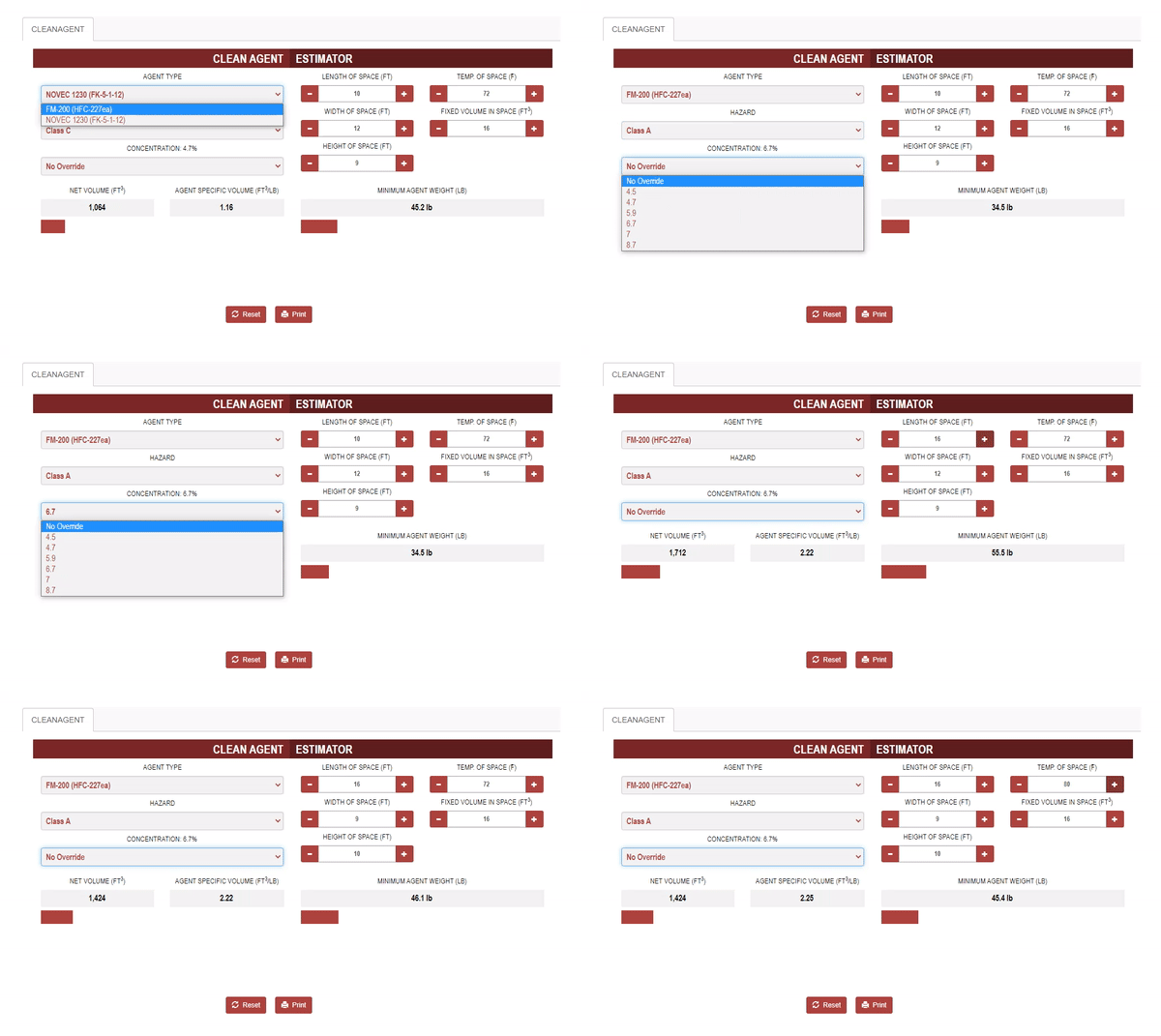
ACCESS THE CLEAN-AGENT ESTIMATOR
Picture

Do you see this tool being useful for what you do? What would make it better? Feel free to comment below here with ideas or feedback.

Don't get these free tools? Subscribe here.

Thanks & have a great week!
    Picture
    Why Sponsor?

    ALL-ACCESS

    Picture
    GET THE TOOLKIT

    SUBSCRIBE

    Get Free Articles via Email:
    + Get calculators, tools, resources and articles
    + Get our PDF Flowchart for Canopy & Overhang Requirements instantly
    Picture
    + No spam
    ​+ Unsubscribe anytime
    I'm Interested In:

    AUTHOR

    Joe Meyer, PE, is a Fire Protection Engineer out of St. Louis, Missouri who writes & develops resources for Fire Protection Professionals. See bio here: About


    FILTERS

    All
    Announcements
    Author Jocelyn Sarrantonio PE
    Book Review
    Calculators
    Career
    Course
    Delegated Design
    Design Challenge
    Detail Critique
    Fire Alarm
    Fire Events
    Fire Suppression
    Flammable & Combustible Liquids
    Flexible Drops
    Floor Control Valve
    Life Safety
    News
    NICET
    Passive Fire Protection
    PE Exam
    Perspective
    Pick A Part
    Pick-A-Part
    Products
    Site Updates
    Special Hazards
    Specifications
    Sprinkler Systems
    Standpipes
    Tools
    Videos


    ARCHIVES

    December 2025
    November 2025
    October 2025
    September 2025
    August 2025
    July 2025
    June 2025
    May 2025
    April 2025
    January 2025
    November 2024
    October 2024
    September 2024
    August 2024
    July 2024
    June 2024
    May 2024
    April 2024
    March 2024
    February 2024
    January 2024
    December 2023
    November 2023
    October 2023
    September 2023
    August 2023
    July 2023
    June 2023
    May 2023
    April 2023
    March 2023
    January 2023
    December 2022
    November 2022
    October 2022
    September 2022
    August 2022
    May 2022
    April 2022
    March 2022
    February 2022
    January 2022
    November 2021
    October 2021
    September 2021
    August 2021
    July 2021
    June 2021
    May 2021
    April 2021
    March 2021
    February 2021
    December 2020
    November 2020
    October 2020
    August 2020
    July 2020
    June 2020
    May 2020
    April 2020
    March 2020
    February 2020
    January 2020
    December 2019
    November 2019
    October 2019
    September 2019
    August 2019
    July 2019
    June 2019
    May 2019
    April 2019
    March 2019
    February 2019
    January 2019
    December 2018
    November 2018
    October 2018
    September 2018
    August 2018
    July 2018
    June 2018
    May 2018
    April 2018
    March 2018
    February 2018
    January 2018
    December 2017
    November 2017
    October 2017
    September 2017
    August 2017
    July 2017
    May 2017
    April 2017
    September 2016
    August 2016
    July 2016
    June 2016
    July 2015
    June 2015
    May 2015

    RSS Feed

Picture
​Home
Our Cause
The Blog
The Forum
PE Exam Prep
The Toolkit

MeyerFire University
​Pricing
Login
​Support
Contact Us
Picture

MeyerFire.com is a startup community built to help fire protection professionals shine.
Our goal is to improve fire protection practices worldwide. We promote the industry by creating helpful tools and resources, and by bringing together industry professionals to share their expertise.

​MeyerFire, LLC is a NICET Recognized Training Provider and International Code Council Preferred Education Provider.

All text, images, and media ​Copyright © 2016-2025 MeyerFire, LLC

We respect your privacy and personal data. See our Privacy Policy and Terms of Service. 
The views, opinions, and information found on this site represent solely the author and do not represent the opinions of any other party, nor does the presented material assume responsibility for its use. Fire protection and life safety systems constitute a critical component for public health and safety and you should consult with a licensed professional for proper design and code adherence.

Discussions are solely for the purpose of peer review and the exchange of ideas. All comments are reviewed. Comments which do not contribute, are not relevant, are spam, or are disrespectful in nature may be removed. Information presented and opinions expressed should not be relied upon as a replacement for consulting services. Some (not all) outbound links on this website, such as Amazon links, are affiliate-based where we receive a small commission for orders placed elsewhere.

  • Blog
  • Forum
  • TOOLKIT
    • ALL TOOLS
    • BUY THE TOOLKIT
  • UNIVERSITY
    • ALL COURSES
    • JOIN THE UNIVERSITY
  • PE Exam
    • PE Forum & Errata
    • PE Store
    • PE Tools
    • PE PREP SERIES
    • PE Old Questions
  • LOGIN
    • TOOLKIT-ONLY LOGIN
    • UNIVERSITY LOGIN
  • STORE
  • OUR CAUSE
    • ABOUT MEYERFIRE
    • JOB OPENINGS
    • BECOME AN INSTRUCTOR
    • HELP/SUPPORT