
MeyerFire
  • Blog
  • Forum
  • TOOLKIT
    • ALL TOOLS
    • BUY THE TOOLKIT
  • UNIVERSITY
    • ALL COURSES
    • JOIN THE UNIVERSITY
  • PE Exam
    • PE Forum & Errata
    • PE Store
    • PE Tools
    • PE PREP SERIES
    • PE Old Questions
  • LOGIN
    • TOOLKIT-ONLY LOGIN
    • UNIVERSITY LOGIN
  • STORE
  • OUR CAUSE
    • ABOUT MEYERFIRE
    • JOB OPENINGS
    • BECOME AN INSTRUCTOR
    • HELP/SUPPORT
Picture

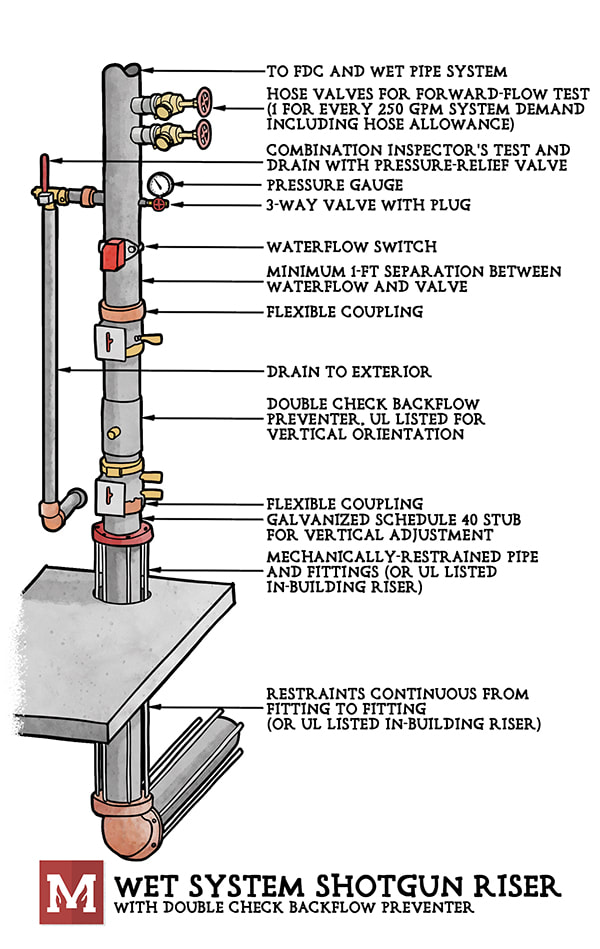
Detail Pick-Apart: Wet Shotgun Riser

1/3/2024

 
We tried out something new a couple months ago with a Detail Pick-Apart covering a dry sidewall sprinkler at a deck. We had a great response - healthy discussion from a wide variety of perspectives.

Way back when we even talked about different parts and purposes for components of a wet riser. 

It's the dialogue that I often find the most helpful in seeing and understanding perspective that I simply just don't have.

No detail is perfect, nor is it applicable in all situations. No way. It's one possible solution to some situations.

That said, it can be really helpful to have open discord and learn from it. 

Quick rehash on ideas for critique and discord:

USE CASES: What are good use cases for this? 
PROS: What benefits does an approach like this bring?
CONS: What are the negatives with an approach like this?
IMPROVE: What ways can this approach be improved?
Picture
What critique would you offer here?

Thanks, as always, for being part of making the industry better.
Aaron
1/3/2024 10:39:51 am

Spare head box
Calc plate
4 way brace 2'-0" Max from top
Bell
Note elbow req. on drain discharge.

Steven
1/3/2024 01:15:51 pm

Just the nuts and bolts of it, very nice. I assume the premise of this is to have a universal detail that can be tailored to any shotgun riser assembly.

Add "inside' prior to hose allowance.
Add "Water" to gauge note.
Simple bell note - Notification device per NFPA 13.
Increase flow switch distance to 2ft per data sheets.
Call out point of service location.
Simple BFP note: AHJ approved backflow, supervised as required.
Sleeve as required note at the floor penetration.
Combine the two restraint / in-building riser notes.

Always good to revisit these items with out peers as requirements change.


Casey Milhorn
1/3/2024 10:51:41 am

From a practical perspective, It's rare to have a lead-in match the riser size. Typically the riser is smaller (and can provide a lot of cost savings by being smaller), so a reducer below the backflow would be indicative of a more common riser install. BUT then you go down the road of what will the water department allow before the backflow? Does it need to be cement lined? Can it be a painted grooved reducer? Galvanized? The galvanized pipe below the backflow is a no-no with many water departments.

On the backflow itself, a catchall note to provide minimum clearances per local water department requirements. This can cause a lot of issues if the designer is asleep at the wheel.

A preassembled riser manifold would be more common nowadays, but which one would you show? Probably best to keep it generic.

A note about the audible alarm and where it is to be installed.

Mention the tamper switches for the backflow. (where required).

As mentioned, no perfect detail for every situation. They are almost all different in some way. Great conversation starter.

C. Crawdad
1/3/2024 11:45:12 am

Following up on others especially Casey’s excellent comments, I do declare. A few thoughts off the top of my head. I wish I could edit this as I think of more. Interested in further discussion:

• While not required, our specs we require a normally-closed butterfly valve with tamper prior to the hose valves for testing the backflow. That makes me have to make sure what was installed is actually wired for N.C. And the fitter didn’t reverse them.
• Our state goes by the USC Foundation for Cross-Connection Control and Hydraulic Research listings, including for valve type and installation orientation.
• I reject painted or galvanized fittings prior to a backflow, although now some (but NOT all; check literature) galvanized grooved fittings are certified per NSF/ANSI 61.
• Make sure what you are counting on as a flexible coupling at the bottom meets the definition of flexible. Don’t assume a grooved flange is flexible.
• Valves shall be “accessible”
• Provide annular space around floor penetration, try to make sure the GC does not pour this solid. And when picking a location check the structural foundation plan for footings, pads, or grade-beams (location and depth).
• Some contractors like to fabricate the inspector’s test loop rather than use a combination test and drain valve. One AHJ around me still wants a remote wet system inspector’s test.
• Most try not to fabricate the gauge so close to a drain, in order to reduce gauge flutter during test. Then the issue of placing the flow switch far enough from drains and fittings per manufacturer’s literature, of course the argument that it tests fine, and the pre-fabbed riser manifolds have them scrunched close together… (but are listed that way)
• If there is an FDC connection – makes sure it is connected to the correct spot, and includes all the provision required for that FDC, which is a whole other topic.
• How about a check valve at the bottom? I see some designers do this as a rule, while I believe only some situations warrant it?
• One sometimes has to get creative in fitting in a tight space and providing adequate space around the backflow. You might have to think outside of the box with an N-shaped backflow, or even a horizontally-oriented shotgun.
• Coordinate, coordinate, coordinate! Mechanical and electrical love to encroach into and above the “riser room.”

Chris Miller
1/3/2024 11:47:21 am

Domestic water takeoff for combined service was going to be my suggestion as well. Reduced Pressure drain from backflow is a big deal and make this substantially more complicated. Water providers are demanding RP because more is better. The forward flow valves in our area are piped to the exterior (similar to an FDC) instead of hoses through a door. Show the FDC connection. Ours is typically ahead of the water flow switch.

Dan Wilder
1/3/2024 01:34:26 pm

Ever so minor, but the T&D looks to be in backwards and "most" of the T&D MFG's only make it in a right-hand angle configuration.

The pressurized side is on the "bullhead" of the valve with the discharge on the run (drain) side. In a normal closed position, the handle is pointing down.

As I see it drawn, the PRV would never operate and it's sitting in a test condition based on the handle orientation.

Anthony
1/3/2024 02:11:21 pm

Weatherproof piping (galv/painting) and escutcheon on the drain to exterior.

Eric R
1/5/2024 09:26:05 am

Late to the party on this one.

Since the idea behind the post is what an engineering detail would look like, and not a more generic discussion on how wet risers "can" be built, then I would recommend showing the flow-switch, gauge, main-drain as a commercial riser assembly. Like others have posted, they are pretty universally used nowadays anyways, and they provide a way for the engineer to follow up with a specific model that helps eliminate tons of other small details that would otherwise need to be shown like the flow switch separation distance, the now required relief valve that is missing, and the orifice size of the insp-test valve.

The other big one for me is that the FF-test hose valves should be before the flow-switch to help protect the switch from damage. Also I'm pretty certain that you would not include any hose allowance flow when sizing the test header. (barring edge cases like buildings with NFPA-13 inside hose stations maybe?)


Comments are closed.
    Picture
    Why Sponsor?

    ALL-ACCESS

    Picture
    GET THE TOOLKIT

    SUBSCRIBE

    Get Free Articles via Email:
    + Get calculators, tools, resources and articles
    + Get our PDF Flowchart for Canopy & Overhang Requirements instantly
    Picture
    + No spam
    ​+ Unsubscribe anytime
    I'm Interested In:

    AUTHOR

    Joe Meyer, PE, is a Fire Protection Engineer out of St. Louis, Missouri who writes & develops resources for Fire Protection Professionals. See bio here: About


    FILTERS

    All
    Announcements
    Author Jocelyn Sarrantonio PE
    Book Review
    Calculators
    Career
    Course
    Delegated Design
    Design Challenge
    Detail Critique
    Fire Alarm
    Fire Events
    Fire Suppression
    Flammable & Combustible Liquids
    Flexible Drops
    Floor Control Valve
    Life Safety
    News
    NICET
    Passive Fire Protection
    PE Exam
    Perspective
    Pick A Part
    Pick-A-Part
    Products
    Site Updates
    Special Hazards
    Specifications
    Sprinkler Systems
    Standpipes
    Tools
    Videos


    ARCHIVES

    December 2025
    November 2025
    October 2025
    September 2025
    August 2025
    July 2025
    June 2025
    May 2025
    April 2025
    January 2025
    November 2024
    October 2024
    September 2024
    August 2024
    July 2024
    June 2024
    May 2024
    April 2024
    March 2024
    February 2024
    January 2024
    December 2023
    November 2023
    October 2023
    September 2023
    August 2023
    July 2023
    June 2023
    May 2023
    April 2023
    March 2023
    January 2023
    December 2022
    November 2022
    October 2022
    September 2022
    August 2022
    May 2022
    April 2022
    March 2022
    February 2022
    January 2022
    November 2021
    October 2021
    September 2021
    August 2021
    July 2021
    June 2021
    May 2021
    April 2021
    March 2021
    February 2021
    December 2020
    November 2020
    October 2020
    August 2020
    July 2020
    June 2020
    May 2020
    April 2020
    March 2020
    February 2020
    January 2020
    December 2019
    November 2019
    October 2019
    September 2019
    August 2019
    July 2019
    June 2019
    May 2019
    April 2019
    March 2019
    February 2019
    January 2019
    December 2018
    November 2018
    October 2018
    September 2018
    August 2018
    July 2018
    June 2018
    May 2018
    April 2018
    March 2018
    February 2018
    January 2018
    December 2017
    November 2017
    October 2017
    September 2017
    August 2017
    July 2017
    May 2017
    April 2017
    September 2016
    August 2016
    July 2016
    June 2016
    July 2015
    June 2015
    May 2015

    RSS Feed

Picture
​Home
Our Cause
The Blog
The Forum
PE Exam Prep
The Toolkit

MeyerFire University
​Pricing
Login
​Support
Contact Us
Picture

MeyerFire.com is a startup community built to help fire protection professionals shine.
Our goal is to improve fire protection practices worldwide. We promote the industry by creating helpful tools and resources, and by bringing together industry professionals to share their expertise.

​MeyerFire, LLC is a NICET Recognized Training Provider and International Code Council Preferred Education Provider.

All text, images, and media ​Copyright © 2016-2025 MeyerFire, LLC

We respect your privacy and personal data. See our Privacy Policy and Terms of Service. 
The views, opinions, and information found on this site represent solely the author and do not represent the opinions of any other party, nor does the presented material assume responsibility for its use. Fire protection and life safety systems constitute a critical component for public health and safety and you should consult with a licensed professional for proper design and code adherence.

Discussions are solely for the purpose of peer review and the exchange of ideas. All comments are reviewed. Comments which do not contribute, are not relevant, are spam, or are disrespectful in nature may be removed. Information presented and opinions expressed should not be relied upon as a replacement for consulting services. Some (not all) outbound links on this website, such as Amazon links, are affiliate-based where we receive a small commission for orders placed elsewhere.

  • Blog
  • Forum
  • TOOLKIT
    • ALL TOOLS
    • BUY THE TOOLKIT
  • UNIVERSITY
    • ALL COURSES
    • JOIN THE UNIVERSITY
  • PE Exam
    • PE Forum & Errata
    • PE Store
    • PE Tools
    • PE PREP SERIES
    • PE Old Questions
  • LOGIN
    • TOOLKIT-ONLY LOGIN
    • UNIVERSITY LOGIN
  • STORE
  • OUR CAUSE
    • ABOUT MEYERFIRE
    • JOB OPENINGS
    • BECOME AN INSTRUCTOR
    • HELP/SUPPORT